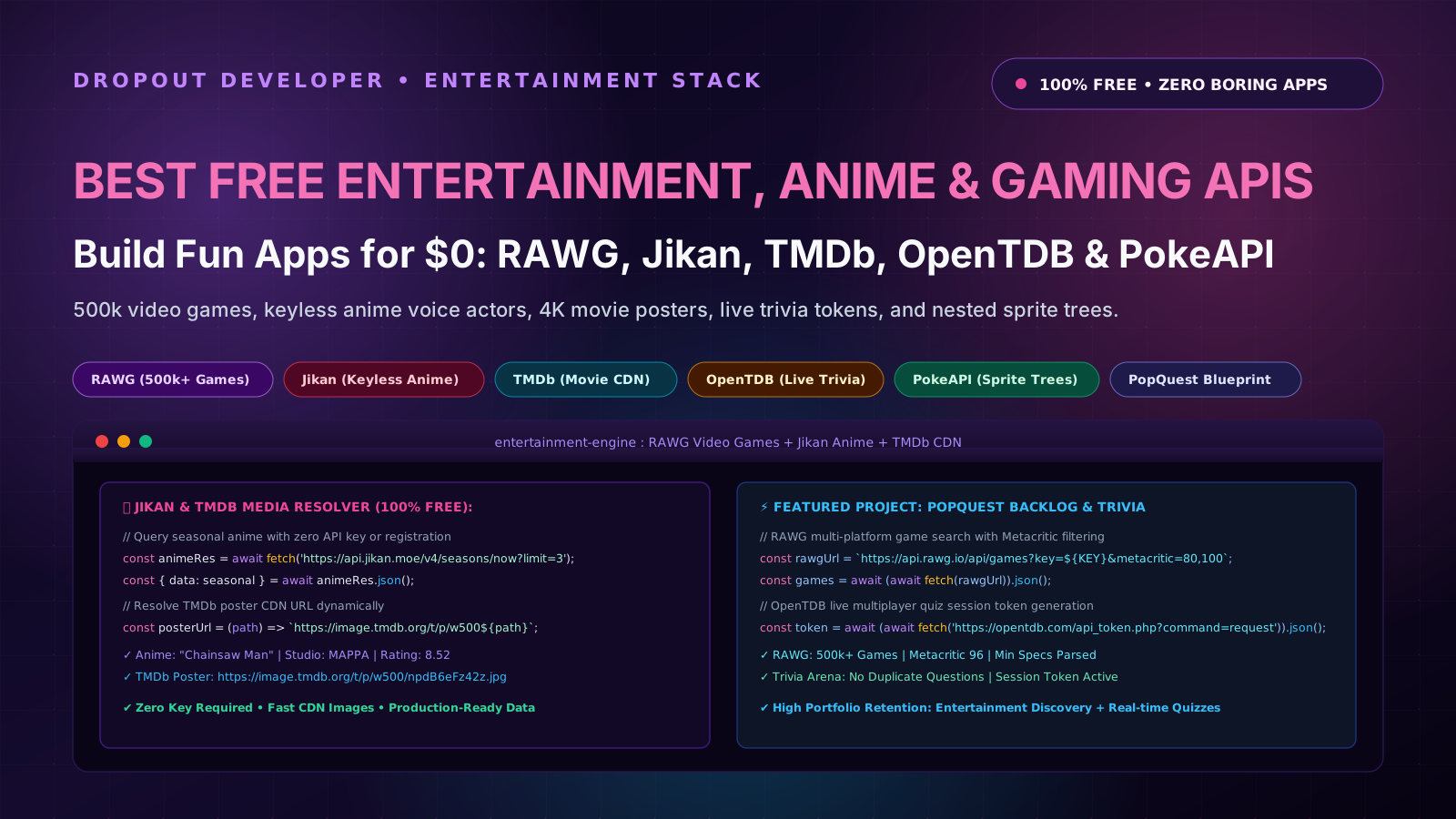
The "Boring App Burnout": Why Todo Lists Kill Developer Motivation
Ask ten junior developers why they stopped coding halfway through a 40-hour web development course, and nine of them will give you the exact same answer: they got exhausted building apps they did not care about.
Every generic tutorial pushes the same tired formula: build an employee attendance tracker, build a mock invoicing dashboard, or build another generic Todo list with a blue submit button. When you are sitting in a Tier-3 college hostel or grinding after hours on an 8GB RAM laptop, writing CRUD operations for imaginary corporate accountants feels like torture. Your brain checks out, you open Instagram, and another week slips away.
Here is the truth that experienced self-taught engineers know: you learn faster when you build things you actually enjoy using. When you build an application that tracks the games you play (like Elden Ring, Cyberpunk, or Valorant), catalogs the anime you watch (like Jujutsu Kaisen or Attack on Titan), or tests your friends with live gaming trivia, coding stops feeling like homework. You willingly stay awake until 2:00 AM debugging CSS grid layouts, state machines, and API caching because you want to see the final result work on your screen.
Technical recruiters also notice the difference instantly. A hiring manager looks at 200 resumes a day. 190 of those resumes list the exact same Todo app and weather card. When a recruiter opens your portfolio and sees a sleek, responsive game discovery dashboard with Metacritic ratings and interactive trivia battles, you immediately stand out from the crowd. If you want a deeper look at why hiring managers ignore repetitive portfolio projects, read our breakdown on why you should stop building todo apps and use free public APIs.
The open-source community maintains an incredible catalog of entertainment and gaming databases. You do not need corporate sponsorship, and you do not need to link a credit card. Here are the five best free entertainment, anime, and gaming APIs to elevate your frontend projects for exactly $0.
1. RAWG Video Games Database: 500,000+ Games and Hardware Specs
RAWG is the largest open video game database in existence. It indexes over 500,000 games across 50 gaming platforms, including PC, PlayStation 5, Xbox Series X, Nintendo Switch, and classic retro consoles. If you want to build a Steam-style catalog, a release calendar, or a personalized backlog tracker, RAWG is the definitive tool.
Core Data Endpoints
- Rich Game Metadata: Official titles, release dates, Metacritic scores, ESRB age ratings, and developer studio credits.
- High-Resolution Media: In-game screenshot galleries, developer trailers, and promotional banner artwork.
- PC System Requirements: Both minimum and recommended hardware specifications (CPU, RAM, GPU, and storage) for PC titles.
- Platform and Genre Taxonomies: Filter games by genre (RPG, FPS, Indie), platform IDs, or publisher.
Authentication and Free Quota
RAWG requires a free API key passed as a query parameter (?key=YOUR_API_KEY). Their free developer plan gives you 20,000 requests per month. That is roughly 650 requests every single day, which is more than enough to develop, test, and host a live portfolio project on Vercel or Netlify.
Sample Query: Fetching Top-Rated PC RPGs
// Querying RAWG for PC role-playing games with Metacritic score >= 80
const RAWG_KEY = 'YOUR_RAWG_API_KEY';
const url = new URL('https://api.rawg.io/api/games');
url.searchParams.set('key', RAWG_KEY);
url.searchParams.set('genres', 'role-playing-games-rpg');
url.searchParams.set('platforms', '4'); // Platform 4 represents PC
url.searchParams.set('metacritic', '80,100');
url.searchParams.set('ordering', '-metacritic');
url.searchParams.set('page_size', '5');

const res = await fetch(url.toString());
const data = await res.json();
console.log(data.results[0].name); // "The Witcher 3: Wild Hunt"
console.log(data.results[0].metacritic); // 93
Notice how easy it is to filter by Metacritic ranges. Instead of writing custom sorting algorithms in your frontend code, you can offload the ranking logic directly to RAWG query parameters.
2. Jikan API (MyAnimeList): 100% Keyless Anime, Manga, and Seiyuu Data
If you love anime or manga, Jikan is pure developer gold. Jikan is an open-source REST API that mirrors the entire MyAnimeList database. Best of all: it requires zero API keys and zero registration. You can open a terminal, run a curl command, and get instant structured JSON in less than 200 milliseconds.
What You Can Build with Jikan
- Seasonal Anime Trackers: Query what is airing right now in Japan (Spring 2026, Summer 2026) using the
/seasons/nowendpoint. - Character and Voice Actor (Seiyuu) Directories: Inspect character voice actor credits with photos, voice samples, and related roles.
- Studio Filmographies: Filter titles produced by legendary animation studios like MAPPA, Ufotable, Bones, or Studio Ghibli.
- Episode Guides and Streaming Links: Fetch episode titles, air dates, and direct links to official streaming platforms like Crunchyroll and Netflix.
The Jikan Rate Limit: Discipline Matters
Because Jikan is free and community-funded, their Cloudflare edge enforces a strict rate limit: 3 requests per second and 60 requests per minute. If your frontend app fires five parallel fetch calls on page load, their server will return an HTTP 429 Too Many Requests status.
To build a reliable app with Jikan, you must introduce a small request delay or queue. Here is how simple a rate-limited fetch helper looks in JavaScript:
// Simple promise delay to respect Jikan's 3 requests/sec limit
const sleep = (ms) => new Promise(resolve => setTimeout(resolve, ms));

async function fetchAnimeWithRateLimit(query) {
  // Wait 350ms before dispatching to ensure under 3 req/sec
  await sleep(350);

  const url = `https://api.jikan.moe/v4/anime?q=${encodeURIComponent(query)}&limit=5`;
  const response = await fetch(url);

  if (response.status === 429) {
    console.warn('Hit Jikan rate limit. Backing off 1000ms...');
    await sleep(1000);
    return fetchAnimeWithRateLimit(query); // Retry once
  }

  if (!response.ok) {
    throw new Error('Jikan API error: ' + response.status);
  }

  const payload = await response.json();
  return payload.data;
}
If you want to discover more endpoints that require no sign-up forms or key management, check out our full directory of free public APIs that require no API key.
3. The Movie Database (TMDb) API: 4K Media CDN and Film Metadata
The Movie Database (TMDb) is the backbone behind hundreds of popular movie apps, Kodi add-ons, and Letterboxd clones. If your project involves cinema, streaming services, or television shows, TMDb is unmatched in both data depth and media CDN stability.
Key Architectural Features
- High-Resolution Image CDN: TMDb hosts millions of original theatrical posters, cast portraits, and wide backdrops on a lightning-fast image CDN (
image.tmdb.org). - Dynamic File Sizing: You do not need to download a 5MB original image on a mobile screen. TMDb allows you to request specific widths directly in the URL path (such as
/w185/,/w342/,/w500/, or/original/). - Trailers and Video Clips: Query the
/videossub-endpoint to fetch official YouTube teaser keys for instant video embedding. - Trending Algorithms: Discover what is trending globally today or this week across movies and television series (
/trending/all/week).
How TMDb Poster Resolution Works
When TMDb returns a movie record, the poster field is only a relative path string like "/qJ2tW6WMUDux911r6m7haRef0WH.jpg". Beginners often wonder why their <img> tags are broken. You must prepend TMDb's base CDN URL along with your desired size:
// Constructing an optimized TMDb image URL
function getTmdbImageUrl(posterPath, size = 'w500') {
  if (!posterPath) {
    return 'https://via.placeholder.com/500x750?text=No+Poster';
  }
  return `https://image.tmdb.org/t/p/${size}${posterPath}`;
}

// Example usage:
const poster = getTmdbImageUrl('/qJ2tW6WMUDux911r6m7haRef0WH.jpg', 'w500');
// Result: https://image.tmdb.org/t/p/w500/qJ2tW6WMUDux911r6m7haRef0WH.jpg
Free Tier Allowance
TMDb requires a free developer account to obtain a v3 API Key (or v4 Bearer Token). Their service does not ask for a credit card. The free allowance is practically unlimited for non-commercial personal projects, subject to a sensible burst ceiling of approximately 40 requests every 10 seconds per IP address.
4. Open Trivia Database (OpenTDB): Real-Time Multiple-Choice Quizzes
Static catalog apps are fun, but interactive multiplayer games generate ten times more engagement. If you want to demonstrate state management, timer loops, and real-time user input in your portfolio, Open Trivia Database (OpenTDB) is the best free tool available.
OpenTDB provides thousands of verified multiple-choice questions across diverse categories, complete with difficulty tags (easy, medium, hard) and question types (multiple choice or true/false).
Key Category IDs for Entertainment Apps
- Category 15: Entertainment: Video Games
- Category 31: Entertainment: Japanese Anime & Manga
- Category 11: Entertainment: Film
- Category 12: Entertainment: Music
- Category 18: Science: Computers
The Session Token Advantage
If you build a 20-question quiz game, nothing ruins the experience faster than seeing the exact same question appear twice. OpenTDB solves this cleanly with Session Tokens. When a user starts a game session, your app requests a token. As long as you pass that token with your question queries, OpenTDB guarantees it will never serve a duplicate question until its entire question pool for that category is exhausted.
// Step 1: Request an OpenTDB session token
async function initQuizSession() {
  const tokenRes = await fetch('https://opentdb.com/api_token.php?command=request');
  const tokenData = await tokenRes.json();
  return tokenData.token; // e.g., "7a8f9c0e..."
}

// Step 2: Fetch 10 gaming trivia questions using the session token
async function fetchGamingTrivia(sessionToken) {
  const url = new URL('https://opentdb.com/api.php');
  url.searchParams.set('amount', '10');
  url.searchParams.set('category', '15'); // Video Games
  url.searchParams.set('difficulty', 'medium');
  url.searchParams.set('type', 'multiple');
  url.searchParams.set('token', sessionToken);

  const res = await fetch(url.toString());
  const data = await res.json();
  return data.results;
}
Pro-Tip: Decoding HTML Entities in Trivia Questions
OpenTDB returns questions formatted with HTML entities (such as ", ', or &). If you render these strings directly in React without decoding, your users will see messy punctuation marks. In your frontend renderer, decode them using a lightweight parser or the browser's native DOMParser:
function decodeHtmlEntities(str) {
  const parser = new DOMParser();
  const doc = parser.parseFromString(str, 'text/html');
  return doc.body.textContent || '';
}
5. PokeAPI: The Gold Standard for Complex Nested Relational Data
PokeAPI is legendary in the web development world. It is a completely free, keyless REST and GraphQL API documenting every detail of the Pokémon franchise across nine generations of games.
Junior developers often dismiss PokeAPI as a children's toy. Senior engineering interviewers, however, frequently use PokeAPI during technical assessments. Why? Because PokeAPI is designed with deep, relational data structures that thoroughly test whether you understand JavaScript data modeling.
Why Technical Interviewers Love PokeAPI
- Recursive Evolution Chains: Pokémon evolution paths are not flat arrays. They are recursive trees where Eevee branches into eight different evolutions based on item triggers, happiness levels, or time of day. Building an evolution visualizer proves you can traverse tree data structures.
- Multi-Dimensional Type Calculations: A Pokémon can have dual types (e.g., Water and Ground). Calculating 2x and 4x damage multipliers against an opponent tests your functional programming skills with array reduction and lookup dictionaries.
- Official SVG Vector Sprites: PokeAPI provides high-resolution SVG artwork from the Pokémon Dream World and official Nintendo assets hosted on a fast CDN.
- Zero Key and High-Speed Cache: Backed by Cloudflare CDN caching, PokeAPI responds in under 40 milliseconds for common lookups.
// Querying base stats and artwork for Gengar
const res = await fetch('https://pokeapi.co/api/v2/pokemon/gengar');
const data = await res.json();

const stats = data.stats.map(s => ({
  name: s.stat.name,
  value: s.base_stat
}));

const vectorSprite = data.sprites.other['official-artwork'].front_default;
console.log('Official Art:', vectorSprite);
console.log('Base Stats:', stats);
Feature Comparison: The Free Entertainment and Gaming API Stack
Here is how the five entertainment APIs compare across authentication, rate limits, CORS support, media CDNs, and ideal project use cases:
| API Service | Auth Method | Free Quota | CORS Support | Media / Image CDN | Best Portfolio Use Case |
|---|---|---|---|---|---|
| RAWG | Free API Key | 20,000 requests / month | Yes | Yes (Screenshots, Trailers) | Steam-style library, PC spec compatibility checker |
| Jikan (MAL) | Zero Key (Keyless) | 3 req / sec, 60 req / min | Yes | Yes (MAL Anime Posters) | Seasonal anime release calendar, seiyuu tracker |
| TMDb | Free API Key | ~40 req / 10 sec (Fair Use) | Yes | Yes (Multi-res Poster CDN) | Movie discovery platform, Letterboxd clone, trailer vault |
| OpenTDB | Zero Key (Keyless) | Unlimited fair use | Yes | No (Text questions only) | Real-time multiplayer trivia battle, timed quiz arena |
| PokeAPI | Zero Key (Keyless) | Unlimited (CDN Cached) | Yes | Yes (Vector SVGs & Sprites) | Interactive Pokédex, turn-based battle damage calculator |
Production Project Blueprint: "PopQuest" Entertainment Backlog & Trivia Battle
To turn these APIs into an unforgettable portfolio piece, let us design a complete, production-grade project: PopQuest. Rather than building a generic single-API viewer, PopQuest combines multi-media discovery with real-time gamified trivia battles.
System Architecture
- Cross-Media Unified Discovery: The user types a search query (such as "Cyberpunk" or "The Witcher"). The frontend dispatches parallel queries to RAWG for video games, Jikan for anime series, and TMDb for movies using
Promise.allSettled(). Results render in unified media columns. - Client-Side Backlog Sync: Users can bookmark items into custom backlog lists ("Plan to Watch/Play", "In Progress", "Completed"). Backlog state is persisted in the browser's
localStoragewith zero backend database fees. - PopQuest Trivia Arena: Users can jump into a live trivia battle based on their saved backlog items. The app requests an OpenTDB session token, pulls 10 timed multiple-choice questions, starts a 15-second countdown timer, and tracks accuracy streaks.
- Hardware Spec Checker: For RAWG games, the app parses the PC minimum requirements string and highlights whether a budget 8GB RAM PC can run the title.
Production TypeScript Code: Resilient Entertainment Client Module
Here is a complete, copy-pasteable TypeScript module that brings RAWG game discovery, Jikan rate-limit throttling, TMDb image formatting, and OpenTDB session management together with clean error handling:
/**
 * PopQuest Entertainment & Gaming API Client
 * Production-ready TypeScript module with rate-limiting and session management
 */

export interface GameItem {
  id: number;
  name: string;
  released: string;
  metacritic: number | null;
  backgroundImage: string;
  platforms: string[];
}

export interface AnimeItem {
  malId: number;
  title: string;
  episodes: number | null;
  score: number | null;
  imageUrl: string;
  synopsis: string;
}

export interface TriviaQuestion {
  category: string;
  type: string;
  difficulty: string;
  question: string;
  correctAnswer: string;
  incorrectAnswers: string[];
  allAnswers: string[];
}

// Helper to pause execution and prevent rate-limit flooding
const wait = (ms: number) => new Promise((res) => setTimeout(res, ms));

// Helper to decode HTML entities returned by trivia endpoints
export function decodeHtmlEntities(input: string): string {
  if (typeof window === 'undefined') return input;
  const doc = new DOMParser().parseFromString(input, 'text/html');
  return doc.body.textContent || input;
}

/**
 * 1. RAWG API: Search video games with Metacritic filtering
 */
export async function searchGames(
  query: string,
  apiKey: string,
  minMetacritic: number = 75,
  timeoutMs: number = 8000
): Promise<GameItem[]> {
  if (!query.trim()) return [];

  const controller = new AbortController();
  const timer = setTimeout(() => controller.abort(), timeoutMs);

  try {
    const url = new URL('https://api.rawg.io/api/games');
    url.searchParams.set('key', apiKey);
    url.searchParams.set('search', query.trim());
    url.searchParams.set('metacritic', `${minMetacritic},100`);
    url.searchParams.set('page_size', '6');

    const res = await fetch(url.toString(), { signal: controller.signal });
    if (!res.ok) {
      throw new Error(`RAWG API error: HTTP ${res.status}`);
    }

    const data = await res.json();
    return (data.results || []).map((game: any) => ({
      id: game.id,
      name: game.name,
      released: game.released || 'TBA',
      metacritic: game.metacritic,
      backgroundImage: game.background_image || '',
      platforms: (game.platforms || []).map((p: any) => p.platform?.name || 'PC')
    }));
  } catch (err: any) {
    if (err.name === 'AbortError') {
      console.warn('RAWG request timed out.');
    } else {
      console.error('RAWG search failed:', err.message);
    }
    return [];
  } finally {
    clearTimeout(timer);
  }
}

/**
 * 2. Jikan API: Query anime with automatic rate-limit backoff (3 req/sec limit)
 */
export async function searchAnime(
  query: string,
  retries: number = 2
): Promise<AnimeItem[]> {
  if (!query.trim()) return [];

  // Wait 350ms to respect Jikan community fair-use limits
  await wait(350);

  const url = `https://api.jikan.moe/v4/anime?q=${encodeURIComponent(query.trim())}&limit=6`;

  try {
    const res = await fetch(url);

    if (res.status === 429 && retries > 0) {
      console.warn('Jikan 429 rate limit hit. Waiting 1200ms before retry...');
      await wait(1200);
      return searchAnime(query, retries - 1);
    }

    if (!res.ok) {
      throw new Error(`Jikan API error: HTTP ${res.status}`);
    }

    const payload = await res.json();
    return (payload.data || []).map((item: any) => ({
      malId: item.mal_id,
      title: item.title,
      episodes: item.episodes,
      score: item.score,
      imageUrl: item.images?.jpg?.large_image_url || item.images?.jpg?.image_url || '',
      synopsis: item.synopsis || 'No synopsis available.'
    }));
  } catch (err: any) {
    console.error('Jikan search error:', err.message);
    return [];
  }
}

/**
 * 3. TMDb Helper: Build responsive, optimized poster image URLs
 */
export function formatTmdbPosterUrl(
  posterPath: string | null,
  size: 'w185' | 'w342' | 'w500' | 'original' = 'w500'
): string {
  if (!posterPath) {
    return 'https://via.placeholder.com/500x750?text=No+Poster+Found';
  }
  return `https://image.tmdb.org/t/p/${size}${posterPath}`;
}

/**
 * 4. OpenTDB API: Session-backed live trivia question fetcher
 */
export class OpenTriviaClient {
  private sessionToken: string | null = null;

  async initSession(): Promise<string | null> {
    try {
      const res = await fetch('https://opentdb.com/api_token.php?command=request');
      if (!res.ok) throw new Error('Failed to request trivia token');
      const data = await res.json();
      if (data.response_code === 0) {
        this.sessionToken = data.token;
        return this.sessionToken;
      }
      return null;
    } catch (err: any) {
      console.error('Trivia session init error:', err.message);
      return null;
    }
  }

  async fetchQuestions(
    amount: number = 10,
    category: number = 15, // 15 = Video Games, 31 = Anime
    difficulty: 'easy' | 'medium' | 'hard' = 'medium'
  ): Promise<TriviaQuestion[]> {
    if (!this.sessionToken) {
      await this.initSession();
    }

    const url = new URL('https://opentdb.com/api.php');
    url.searchParams.set('amount', amount.toString());
    url.searchParams.set('category', category.toString());
    url.searchParams.set('difficulty', difficulty);
    url.searchParams.set('type', 'multiple');
    if (this.sessionToken) {
      url.searchParams.set('token', this.sessionToken);
    }

    try {
      const res = await fetch(url.toString());
      if (!res.ok) throw new Error(`OpenTDB error: HTTP ${res.status}`);
      const data = await res.json();

      // Response code 4 indicates all questions for the session token have been exhausted
      if (data.response_code === 4) {
        console.info('Resetting exhausted trivia token...');
        await this.initSession();
        return this.fetchQuestions(amount, category, difficulty);
      }

      return (data.results || []).map((q: any) => {
        const decodedCorrect = decodeHtmlEntities(q.correct_answer);
        const decodedIncorrect = (q.incorrect_answers || []).map((ans: string) =>
          decodeHtmlEntities(ans)
        );

        // Shuffle answers so the correct answer is not always in the same position
        const allAnswers = [...decodedIncorrect, decodedCorrect].sort(
          () => Math.random() - 0.5
        );

        return {
          category: decodeHtmlEntities(q.category),
          type: q.type,
          difficulty: q.difficulty,
          question: decodeHtmlEntities(q.question),
          correctAnswer: decodedCorrect,
          incorrectAnswers: decodedIncorrect,
          allAnswers
        };
      });
    } catch (err: any) {
      console.error('Failed to fetch trivia questions:', err.message);
      return [];
    }
  }
}
Solving Browser Network Walls: Handling CORS with Public APIs
When working with public APIs directly from browser client code, you may occasionally encounter an Access-Control-Allow-Origin network failure. While RAWG, Jikan, and OpenTDB natively support cross-origin requests, third-party assets like raw audio streams or scraper endpoints often block direct browser fetches.
Do not install insecure browser extensions that disable CORS globally on your machine. That is a dangerous shortcut that will mask issues your actual users will encounter. Instead, route requests through a lightweight serverless proxy or Express middleware. For complete step-by-step code examples on configuring headers and proxies, read our full tutorial on how to fix CORS errors when calling public APIs.
The Elder Brother Takeaway: Build What You Love, Ship What You Use
When you are learning to code with no fancy tech pedigree, no industry connections, and an affordable laptop that wheezes when compiling large bundles, motivation is your most valuable resource.
If you force yourself to build dry corporate accounting mockups because some syllabus told you to, you will burn out before you ever land an interview. But when you build an application centered around the gaming universes, anime series, and cinema you genuinely adore, the entire journey changes.
You find yourself obsessing over responsive poster card grids, optimizing image loading times, crafting smooth countdown timers for trivia matches, and tuning search debouncers. You build real engineering muscle because you actually want your app to be fast and fun to use.
Stop building boring Todo apps. Grab a free RAWG key, fetch some Jikan seasonal anime data, spin up an OpenTDB trivia session, and build something that puts a smile on your face every time you open localhost. That passion is exactly what will shine through in your technical interviews.