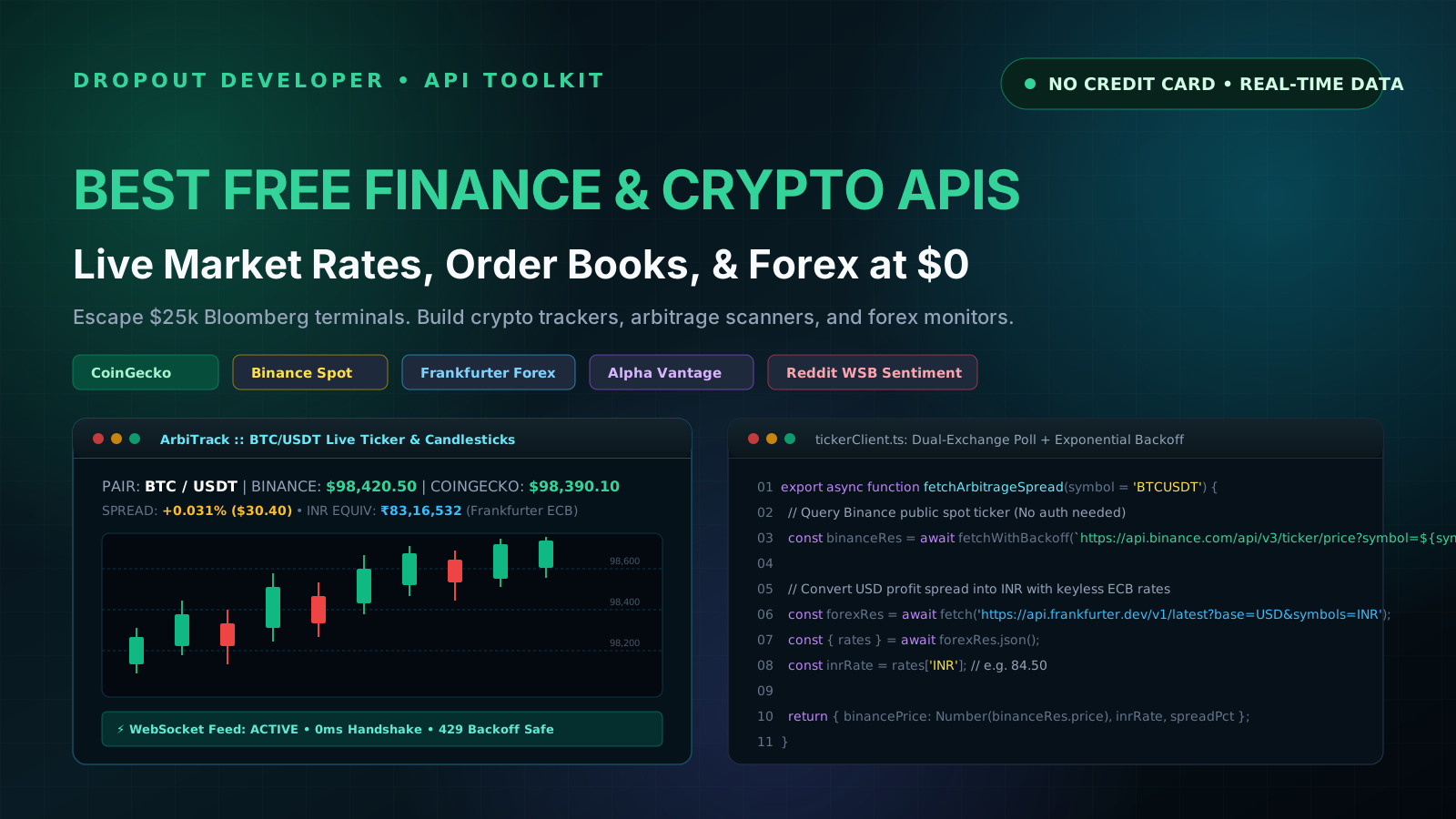
The $25,000 Problem: Bloomberg Terminals vs. Tier-3 Reality
Walk onto the trading floor of any major investment firm in Mumbai or New York, and you will see dual-monitor setups running Bloomberg Terminals. Those black-and-amber screens cost roughly $25,000 per user every single year. For a self-taught programmer hacking away on an 8GB RAM laptop in a small bedroom, $25,000 is an impossible sum: it is more than five entire years of an entry-level 3.5 LPA mass-recruiter service bond.
When you start learning web development and search for financial APIs, commercial platforms try to sell you the same enterprise dream. Services like Polygon.io or Finnhub offer free tiers, but the moment you want real-time intraday candlestick data, historical tick feeds, or reliable crypto order books, you hit a hard paywall. They ask for an international credit card and demand $99 every month.
If you are an Indian college student or an engineer on a ₹0 budget, spending ₹8,000 every month on an API subscription just to build a weekend portfolio app makes zero sense.
The truth is simple: you do not need Wall Street capital to build production-grade financial applications. In our previous guide on Why You Should Stop Building Todo Apps, we talked about building tools that solve real economic problems. The open-source community tracks dozens of reliable, free financial data feeds on github.com/public-apis/public-apis.
Today, we examine the 5 best free finance and crypto APIs that require zero credit cards, provide reliable real-time and historical data, and cost exactly $0.
1. CoinGecko API: The Encyclopedia of Crypto Assets
Official Website: coingecko.com/en/api
Authentication: Free Demo API Key (or keyless public endpoint)
Free Rate Limit: 30 calls per minute (up to 500,000 calls per month on Demo tier)
CORS Enabled: Yes (frontend friendly)
CoinGecko is the gold standard for cryptocurrency market data. While commercial exchanges focus only on the tokens traded on their own platforms, CoinGecko aggregates data across more than 1,000 crypto exchanges and tracks over 14,000 individual digital assets.
With their free API tier, you get live spot prices, total market capitalization, 24-hour trading volume, historical price changes across 1 hour, 24 hours, and 7 days, plus full 7-day sparkline charts formatted as raw numeric arrays.
Key Superpowers:
- Multi-Currency Conversion: You can query a token price against multiple fiat and crypto pairings in a single request (for example, comparing Bitcoin simultaneously in USD, EUR, and INR).
- Sparkline Data: Instead of fetching heavy historical candle datasets, you can request
&sparkline=true. The API returns an array of floating-point numbers representing price action over the past 7 days, perfect for rendering small SVG sparkline charts with zero frontend lag. - Market Categories: Endpoints allow you to filter tokens by category: Layer 1 blockchains, DeFi protocols, AI tokens, or gaming ecosystems.
Quick Test Endpoint:
https://api.coingecko.com/api/v3/simple/price?ids=bitcoin,ethereum,solana&vs_currencies=usd,inr&include_24hr_change=trueThe Real-World Gotcha:
CoinGecko enforces a strict rate limit of 30 calls per minute on its free tier. If your frontend app fires a fetch request every time a user types in a search box or sets up a 1-second setInterval polling loop, your users will see HTTP 429 "Too Many Requests" within twenty seconds. In the production code section below, we show how to prevent this using in-memory caching and exponential backoff retry logic.
2. Frankfurter API: 100% Keyless European Central Bank Forex Rates
Official Website: frankfurter.dev
Authentication: 100% Keyless (No signup, no tokens, no headers)
Free Rate Limit: Generous fair-use policy (thousands of daily calls)
CORS Enabled: Native browser support
Most commercial currency conversion APIs limit you to 250 requests per month before cutting you off. Frankfurter is completely different: it is an open-source, keyless REST API that tracks reference exchange rates published directly by the European Central Bank (ECB).
If you need to convert USD profits into Indian Rupees (INR), calculate Euro expense reports, or build an international invoice generator, Frankfurter gives you accurate daily rates across more than 30 major fiat currencies without needing any registration. As we covered in our guide on 10 Free Public APIs With No Key or Signup Required, zero-auth APIs let you ship features immediately without configuration friction.
Key Superpowers:
- Historical Currency Time Series: You can request historical exchange rates going all the way back to January 1999. This lets you plot multi-year currency depreciation graphs without paying a single rupee.
- Flexible Base Currencies: While the ECB natively uses the Euro (EUR) as its base, Frankfurter calculates real-time conversions for any supported currency as the base (such as
?base=USD&symbols=INR). - Zero Account Overhead: Perfect for continuous integration tests, student projects, and client-side calculators.
Quick Test Endpoint:
https://api.frankfurter.dev/v1/latest?base=USD&symbols=INR,EUR,GBPThe Real-World Gotcha:
The European Central Bank updates reference exchange rates once every business day at approximately 16:00 Central European Time (CET). Frankfurter is designed for portfolio valuation, accounting, and daily fiat conversion, not for sub-second algorithmic forex scalp trading.
3. Binance Public Spot API: Institutional Market Depth with Zero Auth
Official Website: binance-docs.github.io/apidocs/spot/en/
Authentication: Zero Auth for read-only market data endpoints
Free Rate Limit: 1,200 request weight per minute (IP based)
CORS Enabled: Yes (public market endpoints)
Many beginner developers assume that you need an authenticated Binance account, complete with passport verification and API secret keys, to fetch live crypto prices. That is incorrect. Binance exposes its entire read-only market data infrastructure to the public with zero authentication.
You can query live ticker prices, order book bid/ask depth, recent trade executions, and historical candlestick (kline) bars spanning minutes, hours, or days with a simple fetch() call.
Key Superpowers:
- High-Frequency Market Depth: You can fetch the top 20 bids and asks with exact order quantities in a single call using
/api/v3/depth?symbol=BTCUSDT&limit=20. This lets you build animated order book ladders that rival commercial trading terminals. - Historical Candlesticks (Klines): The
/api/v3/klinesendpoint returns structured Open, High, Low, Close, and Volume (OHLCV) arrays for any timeframe (1m, 5m, 1h, 1d), making it easy to feed charting libraries like Lightweight Charts or Chart.js. - Raw WebSocket Streams: Binance offers a public WebSocket server (
wss://stream.binance.com:9443/ws). You can subscribe to real-time price tick streams without maintaining an active polling loop on your server.
Quick Test Endpoints:
// 24h ticker summary (volume, price change, high, low)
https://api.binance.com/api/v3/ticker/24hr?symbol=BTCUSDT

// 24 one-hour historical candlesticks
https://api.binance.com/api/v3/klines?symbol=BTCUSDT&interval=1h&limit=24
The Real-World Gotcha:
Binance uses a weighted rate limiting system. Different endpoints consume different numbers of weight units (for example, fetching a simple ticker costs 2 weight units, while requesting a deep 1,000-order book depth costs 10 units). Always keep your client request weights within the 1,200 units per minute window to prevent temporary IP bans.
4. ApeWisdom / WallStreetBets Sentiment API: Tracking Social Alpha
Official Website: apewisdom.io/api/
Authentication: Keyless public REST endpoint
Free Rate Limit: Fair use (data refreshes every 15 minutes)
CORS Enabled: Yes
Financial markets do not run purely on math and earnings reports. As the GameStop and meme-token manias proved, retail trader sentiment on platforms like Reddit and X (formerly Twitter) can move billions of dollars of trading volume overnight.
ApeWisdom scrapes discussion forums like Reddit r/wallstreetbets, r/stocks, and r/CryptoCurrency in real time. It parses ticker symbols, counts upvotes and comments, and computes sentiment rankings showing which assets are gaining or losing retail momentum.
Key Superpowers:
- Retail Mentions & Upvote Counts: You can see exactly how many times a ticker like NVDA, TSLA, or BTC was mentioned in the last 24 hours.
- Sentiment Rank Dynamics: The API returns a comparison against the previous day rank, allowing you to highlight viral breakouts before they hit mainstream financial news.
- Portfolio Project Value: Combining sentiment rankings with price charts demonstrates natural language processing awareness and social data visualization to hiring managers.
Quick Test Endpoint:
https://apewisdom.io/api/v1.0/filter/wallstreetbets/The Real-World Gotcha:
Social sentiment data is noisy. Retail chatter on Reddit includes sarcasm, memes, and bot activity. Never use sentiment as an automated trading signal by itself; instead, treat it as an auxiliary indicator alongside volume and price action.
5. Alpha Vantage: Technical Indicators & US Equity OHLCV
Official Website: alphavantage.co
Authentication: Free API Key (Instant email verification, no credit card)
Free Rate Limit: 25 requests per day (5 calls per minute)
CORS Enabled: Yes
Alpha Vantage has been a staple in academic and developer circles for years. While their free tier was reduced to 25 requests per day, it remains one of the few free APIs that calculates complex technical indicators server-side.
Instead of writing your own math routines to compute 14-day Relative Strength Index (RSI), Exponential Moving Averages (EMA), or MACD signal lines, Alpha Vantage computes them on their servers and returns clean JSON data points ready for plotting.
Key Superpowers:
- Built-In Technical Analysis: Endpoints for RSI, SMA, EMA, Bollinger Bands, and Stochastic Oscillators eliminate the need for heavy client-side mathematical packages.
- US Stock Equities: Access daily historical OHLCV bars for Apple (AAPL), Microsoft (MSFT), Nvidia (NVDA), and thousands of other publicly traded US corporations.
- Forex and Commodities: Access daily prices for Gold, Crude Oil, Natural Gas, and major currency pairs.
Quick Test Endpoint:
https://www.alphavantage.co/query?function=RSI&symbol=IBM&interval=daily&time_period=14&series_type=close&apikey=demoThe Real-World Gotcha:
With only 25 calls allowed per day on the free tier, you cannot trigger Alpha Vantage directly on user page loads. You must fetch the indicator data once during a scheduled build or store the response in a local SQLite database or browser cache. If you encounter cross-origin issues during local development, review our guide on How to Fix CORS Errors When Calling Public APIs.
Feature Comparison Matrix
Here is how the five finance and crypto APIs compare across authentication friction, free request limits, browser compatibility, and primary strengths:
| API Name | Auth Method | Free Quota | CORS Support | Primary Superpower | Rate Limit Gotcha |
|---|---|---|---|---|---|
| CoinGecko | Free Demo Key / None | 30 calls/minute | Yes | 14,000+ coins, 7-day sparklines, multi-fiat quotes | Strict 30/min cap; easily triggers HTTP 429 if unthrottled |
| Frankfurter | 100% Keyless | Generous fair use | Yes (Native) | Official European Central Bank daily forex rates (1999 to present) | Updated once daily at ~16:00 CET; not for high-frequency trading |
| Binance Spot | Zero Auth (Read-only) | 1,200 weight/minute | Yes | Spot ticker, order book depth, klines, public WebSocket feed | Weight varies by endpoint; IP bans if weight exceeds limit |
| ApeWisdom (WSB) | 100% Keyless | Fair-use policy | Yes | Reddit r/wallstreetbets sentiment, ticker mention ranks | Data refreshes every 15 minutes; noisy retail social data |
| Alpha Vantage | Free Key (Instant) | 25 calls/day (5/min) | Yes | Server-side technical indicators (RSI, SMA, MACD) and US equities | Extremely low daily cap requires aggressive caching layers |
Production Project Blueprint: "ArbiTrack" Multi-Exchange Arbitrage & INR Monitor
Most beginners build a crypto tracker that displays the price of Bitcoin. That project does not impress technical recruiters because it is just a basic fetch() and a map function over an array.
To showcase engineering maturity, build ArbiTrack: a real-time crypto arbitrage scanner and INR fiat profit monitor. ArbiTrack compares spot prices across multiple independent liquidity pools, detects price spread anomalies, and calculates potential profit in Indian Rupees using live forex rates.
System Architecture:
- Dual-Exchange Ingestion: The application queries the Binance spot ticker for
BTCUSDTand fetches CoinGecko simple price forbitcoinin USD. Because Binance and decentralized aggregate pools run separate order matching engines, volatile movements create temporary price spreads (often between 0.05% and 0.35%). - Forex Conversion Engine: ArbiTrack queries the Frankfurter API to retrieve the current official USD to INR exchange rate. It caches this rate in memory for 60 seconds to avoid unnecessary network traffic.
- Net Spread & Fee Accounting: A beginner calculates
Spread = PriceA - PriceBand calls it a profit. A professional engineer knows that every trade pays exchange taker fees (roughly 0.10% per transaction). ArbiTrack calculates net profitability after deducting trading fees:Net Profit (%) = ((Higher Price - Lower Price) / Lower Price) * 100 - (2 * Estimated Fee %) - Real-Time WebSocket Stream with Polling Fallback: The app connects to the Binance public WebSocket feed for sub-second updates. If the WebSocket disconnects (due to network drops or tab suspension), it automatically falls back to an HTTP polling loop with exponential backoff.
- 429 Rate Limit Armor: If CoinGecko returns an HTTP 429 status code, our client catches the error, inspects the
Retry-Afterheader, and backs off gracefully instead of crashing the UI.
Production TypeScript Code: Resilient Client with Backoff & WebSocket Fallback
Here is a complete, copy-pasteable TypeScript module. It includes exponential backoff retry handling for HTTP 429 errors, 60-second in-memory caching, live Binance WebSocket streaming, and arbitrage calculation with INR conversion.
Save this file as arbiTrackClient.ts in your project:
/**
 * Production crypto arbitrage client and forex conversion service.
 * Connects to Binance Public Spot, CoinGecko, and Frankfurter APIs.
 */

export interface ArbitrageOpportunity {
  symbol: string;
  binancePriceUsd: number;
  coingeckoPriceUsd: number;
  priceSpreadUsd: number;
  grossSpreadPercent: number;
  netProfitPercent: number;
  estimatedProfitInr: number;
  usdToInrRate: number;
  timestamp: string;
}

interface CacheEntry<T> {
  data: T;
  expiry: number;
}

// In-memory cache to respect rate limits
const memoryCache = new Map<string, CacheEntry<any>>();

/**
 * Reusable fetch wrapper with exponential backoff for HTTP 429 rate limits.
 */
export async function fetchWithBackoff<T>(
  url: string,
  maxRetries: number = 3,
  initialDelayMs: number = 1000
): Promise<T> {
  let delay = initialDelayMs;

  for (let attempt = 1; attempt <= maxRetries; attempt++) {
    try {
      const response = await fetch(url, {
        headers: { 'Accept': 'application/json' },
      });

      if (response.status === 429) {
        const retryAfterHeader = response.headers.get('Retry-After');
        const waitTime = retryAfterHeader ? parseInt(retryAfterHeader, 10) * 1000 : delay;
        console.warn(`[ArbiTrack] Rate limited (429) on ${url}. Retrying in ${waitTime}ms (Attempt ${attempt}/${maxRetries})...`);
        await new Promise((resolve) => setTimeout(resolve, waitTime));
        delay *= 2; // Exponential increase
        continue;
      }

      if (!response.ok) {
        throw new Error(`HTTP Error ${response.status}: ${response.statusText}`);
      }

      return (await response.json()) as T;
    } catch (error: any) {
      if (attempt === maxRetries) {
        throw new Error(`Request failed after ${maxRetries} attempts: ${error.message}`);
      }
      console.warn(`[ArbiTrack] Fetch error (${error.message}). Retrying in ${delay}ms...`);
      await new Promise((resolve) => setTimeout(resolve, delay));
      delay *= 2;
    }
  }

  throw new Error('[ArbiTrack] Exhausted retry attempts.');
}

/**
 * Fetches the current USD to INR exchange rate from Frankfurter API.
 * Uses a 60-second in-memory cache to prevent unnecessary network calls.
 */
export async function getUsdToInrRate(): Promise<number> {
  const cacheKey = 'forex_usd_inr';
  const cached = memoryCache.get(cacheKey);

  if (cached && cached.expiry > Date.now()) {
    return cached.data;
  }

  const url = 'https://api.frankfurter.dev/v1/latest?base=USD&symbols=INR';
  const data = await fetchWithBackoff<{ rates: { INR: number } }>(url);
  const rate = data.rates.INR;

  memoryCache.set(cacheKey, {
    data: rate,
    expiry: Date.now() + 60 * 1000, // 60 seconds TTL
  });

  return rate;
}

/**
 * Fetches latest Binance spot price for a given pair (e.g., BTCUSDT).
 */
export async function getBinanceSpotPrice(symbol: string = 'BTCUSDT'): Promise<number> {
  const url = `https://api.binance.com/api/v3/ticker/price?symbol=${symbol}`;
  const data = await fetchWithBackoff<{ symbol: string; price: string }>(url);
  return parseFloat(data.price);
}

/**
 * Fetches latest CoinGecko price for a given coin id (e.g., bitcoin).
 * Uses a 30-second in-memory cache to respect CoinGecko 30 calls/min rate limits.
 */
export async function getCoinGeckoPrice(coinId: string = 'bitcoin'): Promise<number> {
  const cacheKey = `coingecko_${coinId}`;
  const cached = memoryCache.get(cacheKey);

  if (cached && cached.expiry > Date.now()) {
    return cached.data;
  }

  const url = `https://api.coingecko.com/api/v3/simple/price?ids=${coinId}&vs_currencies=usd`;
  const data = await fetchWithBackoff<Record<string, { usd: number }>>(url);
  const price = data[coinId]?.usd;

  if (!price) {
    throw new Error(`Unable to resolve CoinGecko price for coin id: ${coinId}`);
  }

  memoryCache.set(cacheKey, {
    data: price,
    expiry: Date.now() + 30 * 1000, // 30 seconds TTL
  });

  return price;
}

/**
 * Computes live arbitrage spread and converts profit into Indian Rupees.
 * Assumes a standard 0.10% taker fee per exchange trade (0.20% round-trip).
 */
export async function scanArbitrageOpportunity(
  binanceSymbol: string = 'BTCUSDT',
  coinGeckoId: string = 'bitcoin',
  tradeVolumeUnits: number = 0.5 // e.g., 0.5 BTC
): Promise<ArbitrageOpportunity> {
  const [binancePrice, coingeckoPrice, usdToInr] = await Promise.all([
    getBinanceSpotPrice(binanceSymbol),
    getCoinGeckoPrice(coinGeckoId),
    getUsdToInrRate(),
  ]);

  const priceSpreadUsd = Math.abs(binancePrice - coingeckoPrice);
  const minPrice = Math.min(binancePrice, coingeckoPrice);
  const grossSpreadPercent = (priceSpreadUsd / minPrice) * 100;

  // Deduct 0.10% entry fee + 0.10% exit fee = 0.20% round trip
  const roundTripFeePercent = 0.20;
  const netProfitPercent = grossSpreadPercent - roundTripFeePercent;

  const grossProfitUsd = priceSpreadUsd * tradeVolumeUnits;
  const feesUsd = (binancePrice * tradeVolumeUnits * 0.001) + (coingeckoPrice * tradeVolumeUnits * 0.001);
  const netProfitUsd = grossProfitUsd - feesUsd;
  const estimatedProfitInr = netProfitUsd > 0 ? Math.round(netProfitUsd * usdToInr) : 0;

  return {
    symbol: binanceSymbol,
    binancePriceUsd: binancePrice,
    coingeckoPriceUsd: coingeckoPrice,
    priceSpreadUsd: Math.round(priceSpreadUsd * 100) / 100,
    grossSpreadPercent: Math.round(grossSpreadPercent * 1000) / 1000,
    netProfitPercent: Math.round(netProfitPercent * 1000) / 1000,
    estimatedProfitInr,
    usdToInrRate: usdToInr,
    timestamp: new Date().toISOString(),
  };
}

/**
 * Subscribes to Binance live WebSocket feed for instant ticker updates.
 * Provides an automatic fallback trigger if connection closes or errors.
 */
export function subscribeBinanceWebSocket(
  symbol: string,
  onPriceUpdate: (price: number) => void,
  onConnectionError: (err: Event) => void
): () => void {
  const streamName = `${symbol.toLowerCase()}@ticker`;
  const wsUrl = `wss://stream.binance.com:9443/ws/${streamName}`;
  const socket = new WebSocket(wsUrl);

  socket.onmessage = (event) => {
    try {
      const data = JSON.parse(event.data);
      if (data && data.c) {
        onPriceUpdate(parseFloat(data.c)); // 'c' is the current close price
      }
    } catch (parseError) {
      console.error('[ArbiTrack WS] Failed to parse message:', parseError);
    }
  };

  socket.onerror = (error) => {
    console.warn('[ArbiTrack WS] WebSocket error occurred:', error);
    onConnectionError(error);
  };

  // Return unsubscribe cleanup function
  return () => {
    if (socket.readyState === WebSocket.OPEN || socket.readyState === WebSocket.CONNECTING) {
      socket.close();
      console.log('[ArbiTrack WS] Cleaned up socket connection.');
    }
  };
}
How to Run This in Plain JavaScript:
You can test this logic right now in Node.js or in your browser DevTools. Copy the following snippet to execute a live scan and print the results:
// Quick test script for Node.js 18+ (supports native fetch)
scanArbitrageOpportunity('BTCUSDT', 'bitcoin', 0.25)
  .then((opp) => {
    console.log('--- ARBITRACK LIVE SCAN ---');
    console.log(`Pair: ${opp.symbol}`);
    console.log(`Binance Spot: $${opp.binancePriceUsd.toLocaleString()}`);
    console.log(`CoinGecko Agg: $${opp.coingeckoPriceUsd.toLocaleString()}`);
    console.log(`Spread: $${opp.priceSpreadUsd} (${opp.grossSpreadPercent}%)`);
    console.log(`Net Spread (After 0.2% fees): ${opp.netProfitPercent}%`);
    console.log(`USD/INR Rate (Frankfurter ECB): ₹${opp.usdToInrRate}`);
    console.log(`Estimated Net Profit (on 0.25 BTC): ₹${opp.estimatedProfitInr.toLocaleString()}`);
    console.log('---------------------------');
  })
  .catch((err) => console.error('Scan failed:', err.message));
How to Select the Right Financial API for Your Next App
Do not waste weeks comparing fifty different options. Choose the tool tailored to your exact project scope:
- Choose Binance Public Spot if: You are building high-speed crypto charting tools, live order book visualizers, or WebSocket trading dashboards. Zero authentication on read-only endpoints means you can build and ship with zero setup delay.
- Choose CoinGecko if: You are building multi-token portfolio trackers, token search widgets, or need historical 7-day sparkline charts for thousands of altcoins across multiple blockchain networks.
- Choose Frankfurter if: Your application involves fiat currency conversions, multi-currency SaaS billing displays, travel budgeting, or international expense calculators. Its keyless ECB data is reliable and completely free.
- Choose ApeWisdom (WSB) if: You want to build a social trend aggregator, sentimental hype meter, or meme-stock detector that showcases data visualization and social trend analysis.
- Choose Alpha Vantage if: You are building traditional stock portfolio apps that require server-side calculations for technical indicators like RSI, SMA, and MACD on US equities like Apple and Tesla. Cache results aggressively to respect its 25 calls/day limit.
The Final Takeaway: Precision Over Hype
When I was preparing for coding interviews from a Tier-3 college, my initial portfolio was full of generic projects: a calculator, a weather widget, and a simple todo list. In my first three interviews, nobody even bothered to click the links. Every candidate had the exact same projects.
Everything changed when I built a financial project that reconciled data across two different APIs and calculated real-world net profits in Indian Rupees. When an engineering manager sees that you implemented exponential backoff for HTTP 429 rate limits, added in-memory caching to protect network boundaries, and accounted for trading transaction fees in your business logic, the conversation shifts immediately. They stop treating you like an insecure fresher and start treating you like an engineer who can be trusted with production systems.
Pick Binance and Frankfurter tonight. Set up a clean project. Put live market data on your screen for ₹0, and build something that proves your engineering discipline.