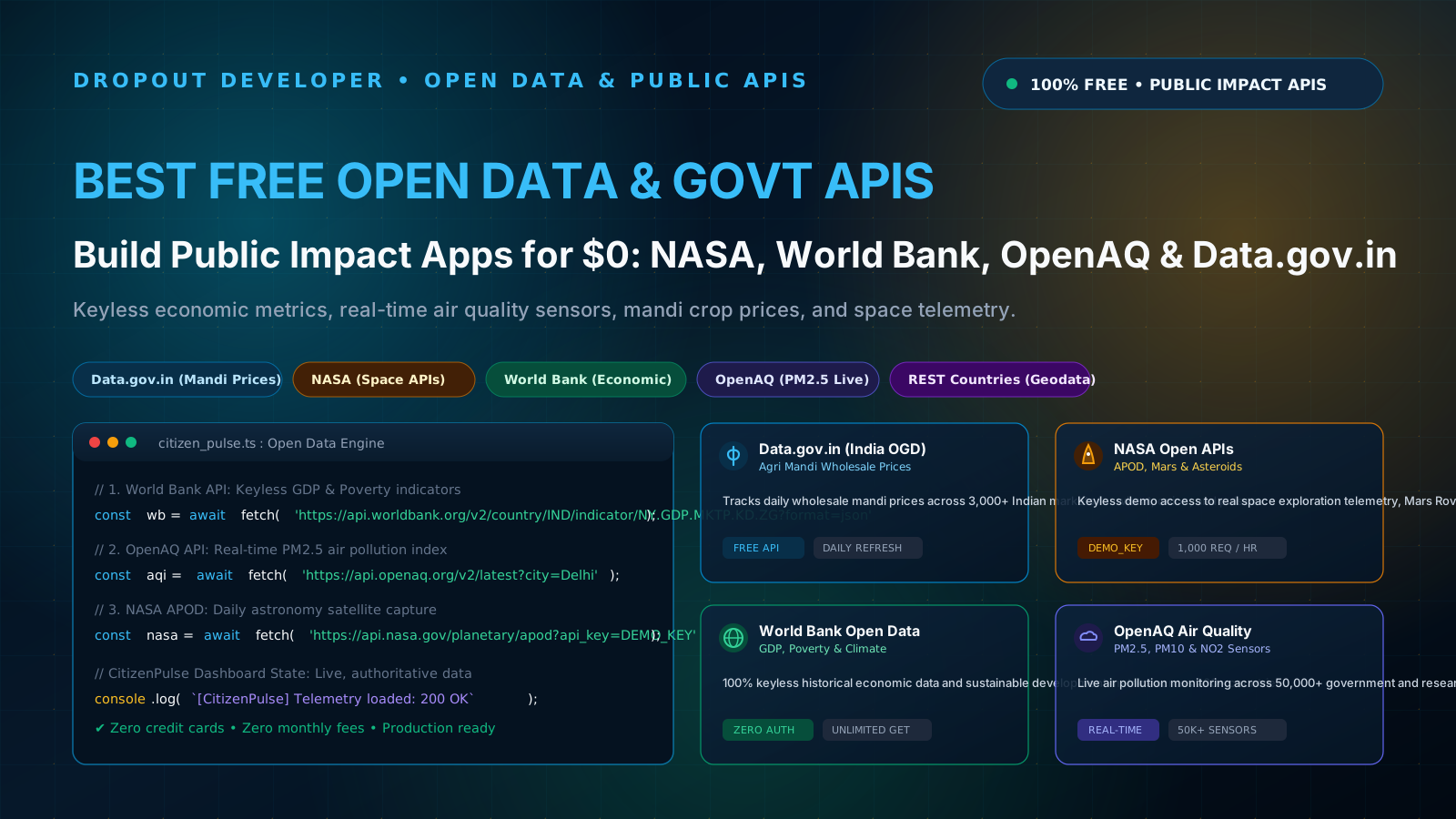
The Clone Fatigue: Why Interviewers Ignore Another Social Media Clone
If you have ever sat across from an engineering interviewer or hiring lead at a high-growth tech startup, they have likely seen fifty developer portfolios in the preceding fortnight. Almost every single applicant brings the exact same collection: a clone of Spotify, a clone of Twitter, and a clone of Netflix created by following five-hour YouTube coding marathons.
Interviewers know precisely how those projects were assembled. You copied the instructor code line for line, populated your components with static JSON fixtures, and never had to wrestle with flaky network latency, inconsistent schemas, or breaking upstream changes. When an interviewer asks what happens when your data source goes down, most candidates freeze.
Now consider a different scenario: You walk into the room, open your browser, and pull up CitizenPulse, an open-source public telemetry dashboard. Your application pulls live agricultural commodity mandi prices across 3,000 Indian markets from Data.gov.in, monitors real-time PM2.5 particulate air quality from 50,000 environmental monitoring stations via OpenAQ, and correlates regional pollution with historical World Bank development indicators.
The entire dynamic changes in seconds. Instead of grilling you on abstract syntax trivia, the interviewer asks: "How do you handle schema variations across different state departments? How did you design your in-memory caching layer so farmers and citizens on spotty 3G cellular networks do not burn mobile data? How do you parse multi-dimensional time-series data without freezing the browser thread?"
When you are grinding in a Tier-3 college hostel or fighting your way out of a 3.5 LPA mass-recruiter service bond on a battered 8GB RAM laptop, you do not have money for enterprise SaaS subscriptions. You need authoritative, production-grade datasets that cost exactly zero rupees. That is the superpower of open data and government APIs: they are massive, permanent, free, and grounded in real-world public impact. If you want to understand why hiring managers disregard generic bootcamp projects, read our guide on why you should stop building todo apps and use free public APIs.
Let us explore the five best free open data and government APIs that will elevate your portfolio and teach you how production systems handle real-world information.
1. Data.gov.in: India Open Government Data Platform
Operated by the National Informatics Centre (NIC) under the Ministry of Electronics and Information Technology, Data.gov.in is the central open data repository of the Government of India. The platform hosts more than 500,000 datasets published by central ministries, state secretariats, and municipal administrations.
For developers in India, building apps with Data.gov.in provides unmatched local credibility. Instead of displaying fictitious sample records, your application surfaces real economic and civic information that impacts millions of citizens every day.
High-Impact Datasets on Data.gov.in
- Agmarknet Wholesale Agricultural Mandi Prices: Daily modal, minimum, and maximum prices for hundreds of commodities (such as onions, wheat, rice, mustard, and tomatoes) across more than 3,000 regulated agricultural mandis nationwide.
- District Health Facilities and Infrastructure: Complete directories of community health centres, sub-district hospitals, and bed availability across rural and urban districts.
- National Postal PIN Code Directory: Official mappings of all 150,000+ Indian postal PIN codes to states, districts, talukas, and delivery post offices.
- Vahan Transport Statistics: Vehicle registration counts, fuel type distributions (petrol, diesel, EV), and regional transport office (RTO) trends across states.
Authentication and Query Structure
Data.gov.in requires a free API key. You register on the portal with an email address, verify your account, and generate your key instantly in the developer console. There is no credit card requirement and no approval delay. Standard developer keys receive a generous allowance of 10,000 requests per day.
Every dataset on Data.gov.in is identified by a unique GUID-style Resource ID. You pass your resource ID, API key, format, and optional filter parameters in your query string:
// Fetching daily wholesale onion mandi prices in Maharashtra from Data.gov.in
async function fetchMandiPrices(apiKey, state = 'Maharashtra', commodity = 'Onion') {
  // Official Agmarknet daily mandi price resource ID
  const resourceId = '9ef84268-d588-465a-a308-a864a43d0070';
  const url = new URL(`https://api.data.gov.in/resource/${resourceId}`);
  url.searchParams.set('api-key', apiKey);
  url.searchParams.set('format', 'json');
  url.searchParams.set('limit', '20');
  url.searchParams.set('filters[state]', state);
  url.searchParams.set('filters[commodity]', commodity);

  const res = await fetch(url.toString());
  if (!res.ok) {
    throw new Error('Data.gov.in request failed with status: ' + res.status);
  }

  const payload = await res.json();
  // Records are nested inside the 'records' array
  return (payload.records || []).map(record => ({
    state: record.state,
    district: record.district,
    market: record.market,
    commodity: record.commodity,
    variety: record.variety,
    arrivalDate: record.arrival_date,
    minPrice: Number(record.min_price),
    maxPrice: Number(record.max_price),
    modalPrice: Number(record.modal_price)
  }));
}
One architectural note: field names returned by Data.gov.in can vary between datasets (some use snake_case while others use camelCase or mixed capitalization). Always inspect the raw payload schema before writing your TypeScript interfaces.
2. NASA Open APIs: Space Telemetry, Mars Rovers, and Asteroids
NASA maintains one of the most generous developer programs in the scientific world. Through their public developer gateway at api.nasa.gov, NASA exposes planetary science data, deep-space imagery, telemetry feeds, and satellite captures from active missions.
Authentication: The DEMO_KEY Shortcut
NASA allows immediate, keyless exploration using their default demo credential: api_key=DEMO_KEY. This allows up to 30 requests per hour and 50 requests per day per IP address, perfect for local prototyping. When you need production throughput, entering your email on api.nasa.gov provides an instant personal API key that boosts your allowance to 1,000 requests per hour, completely free of charge.
Standout NASA Endpoints
- APOD (Astronomy Picture of the Day): Returns the daily cosmic photograph or video captured by Hubble, James Webb, or astrophotographers, accompanied by a description written by an astronomer, 4K high-definition media URLs, and copyright credits.
- Mars Rover Photos: Browse thousands of raw scientific photographs captured on the Martian surface by Curiosity, Perseverance, and Opportunity rovers. You can filter by Earth date or Martian Sol (solar day) and specific camera instruments (such as the Mast Camera or Navigation Camera).
- NeoWs (Near Earth Object Web Service): A RESTful web service for near-Earth asteroid information. It provides estimated asteroid diameters, velocity vectors in kilometres per second, close approach dates, and flags indicating whether NASA classifies the asteroid as potentially hazardous.
- EPIC (Earth Polychromatic Imaging Camera): Daily full-disc color images of Earth taken from a distance of one million miles by the DSCOVR satellite.
// Fetching NASA Astronomy Picture of the Day and tracking Near-Earth Asteroids
async function fetchNasaDailyTelemetry(apiKey = 'DEMO_KEY') {
  // 1. Fetch APOD
  const apodUrl = `https://api.nasa.gov/planetary/apod?api_key=${apiKey}&thumbs=true`;
  const apodRes = await fetch(apodUrl);
  const apodData = await apodRes.json();

  // 2. Fetch Near Earth Asteroids for today
  const today = new Date().toISOString().split('T')[0];
  const neoUrl = `https://api.nasa.gov/neo/rest/v1/feed?start_date=${today}&end_date=${today}&api_key=${apiKey}`;
  const neoRes = await fetch(neoUrl);
  const neoData = await neoRes.json();

  const asteroidsToday = neoData.near_earth_objects?.[today] || [];
  const hazardousAsteroids = asteroidsToday.filter(a => a.is_potentially_hazardous_asteroid);

  return {
    apod: {
      title: apodData.title,
      explanation: apodData.explanation,
      mediaType: apodData.media_type,
      url: apodData.url,
      hdurl: apodData.hdurl
    },
    asteroidCount: asteroidsToday.length,
    hazardousCount: hazardousAsteroids.length
  };
}
3. World Bank Open Data API: 100% Keyless Global Development Metrics
The World Bank Open Data catalog is an extraordinary resource for engineers. It contains thousands of standardized time-series indicators tracking global poverty, economic productivity, agricultural yields, public education, and renewable energy adoption across more than 200 sovereign nations and regional territories, dating back to 1960.
Zero-Auth, Keyless Design
The World Bank Open Data API requires zero authentication. You do not need an account, an API secret, or custom request headers. It provides unlimited fair-use read queries with native browser CORS support.
Core Query Mechanics and Popular Indicators
Requests are structured cleanly using ISO 3166-1 alpha-3 country codes (such as IND for India, USA for the United States, VNM for Vietnam) combined with standardized indicator codes:
NY.GDP.MKTP.KD.ZG: Annual GDP growth rate (percentage).SI.POV.DDAY: Poverty headcount ratio at $2.15 a day (2017 PPP) (% of population).EG.ELC.RURR.ZS: Access to electricity in rural regions (% of rural population).SE.ADT.LITR.ZS: Adult literacy rate (% of people aged 15 and above).EN.ATM.CO2E.PC: Carbon dioxide emissions (metric tons per capita).
The Two-Element Array Architecture
A frequent stumbling block for developers using the World Bank API is its response formatting. When requesting JSON output (via format=json), the API returns a top-level array containing two items:
- Index 0 (Metadata): An object describing pagination details (
page,pages,per_page,total). - Index 1 (Time-Series Records): The array of historical annual measurements for the chosen country and indicator.
// Querying World Bank API for historical GDP growth and rural electricity access
async function fetchWorldBankIndicator(countryCode = 'IND', indicator = 'NY.GDP.MKTP.KD.ZG') {
  const url = new URL(`https://api.worldbank.org/v2/country/${countryCode}/indicator/${indicator}`);
  url.searchParams.set('format', 'json');
  url.searchParams.set('date', '2015:2024'); // Historical 10-year window
  url.searchParams.set('per_page', '50');

  const res = await fetch(url.toString());
  if (!res.ok) {
    throw new Error('World Bank API error: ' + res.status);
  }

  const payload = await res.json();
  // Crucial check: Index 0 is metadata, Index 1 holds the records
  if (!Array.isArray(payload) || payload.length < 2) {
    throw new Error('Unexpected World Bank payload shape');
  }

  const records = payload[1] || [];
  return records
    .filter(item => item.value !== null)
    .map(item => ({
      country: item.country?.value,
      year: parseInt(item.date, 10),
      value: parseFloat(item.value.toFixed(2)),
      indicator: item.indicator?.value
    }))
    .sort((a, b) => a.year - b.year);
}
If you are looking for more keyless endpoints to build clean web applications without account registrations, check out our curated collection of free public APIs without API keys.
4. OpenAQ API: Real-Time Air Quality Monitoring Across 50,000+ Stations
Air pollution is one of the most pressing public health challenges in developing economies. In cities across northern India, the Indo-Gangetic plain, and expanding industrial hubs worldwide, airborne particulate matter (PM2.5 and PM10) routinely exceeds safe World Health Organization guidelines.
OpenAQ is an open environmental platform that aggregates real-time air quality telemetry from official government monitoring stations around the globe (including India Central Pollution Control Board, the US Environmental Protection Agency, and the European Environment Agency).
Why OpenAQ Elevates Your Portfolio
Unlike simulated weather apps that display static numbers, OpenAQ streams live physical sensor telemetry. You are reading actual microgram-per-cubic-meter (µg/m³) measurements taken by calibrated hardware instruments situated on rooftops, municipal towers, and highway interchanges minutes ago.
Core Parameters and Endpoints
- Key Pollutants:
pm25(fine particles under 2.5 micrometers),pm10(coarse dust),no2(nitrogen dioxide),so2(sulfur dioxide),o3(ozone), andco(carbon monoxide). - Latest Measurements Endpoint:
https://api.openaq.org/v2/latestreturns current readings filtered by country, city, or coordinate bounding radius (e.g.coordinates=28.6139,77.2090&radius=25000for Delhi NCR). - Locations Endpoint:
https://api.openaq.org/v2/locationsretrieves metadata about physical stations, hardware manufacturers, and operational status.
// Fetching real-time PM2.5 and PM10 air quality sensors for a chosen city
async function fetchCityAirQuality(apiKey, city = 'Delhi') {
  const url = new URL('https://api.openaq.org/v2/latest');
  url.searchParams.set('city', city);
  url.searchParams.set('limit', '10');

  const headers = {};
  if (apiKey) {
    headers['X-API-Key'] = apiKey;
  }

  const res = await fetch(url.toString(), { headers });
  if (!res.ok) {
    throw new Error('OpenAQ request failed with status: ' + res.status);
  }

  const data = await res.json();
  const results = data.results || [];

  return results.map(station => {
    const measurements = station.measurements || [];
    const pm25 = measurements.find(m => m.parameter === 'pm25');
    const pm10 = measurements.find(m => m.parameter === 'pm10');

    return {
      location: station.location,
      city: station.city,
      country: station.country,
      coordinates: station.coordinates,
      lastUpdated: station.lastUpdated,
      pm25Value: pm25 ? pm25.value : null,
      pm10Value: pm10 ? pm10.value : null,
      unit: pm25?.unit || 'µg/m³'
    };
  });
}
5. REST Countries: 100% Keyless Geopolitical and Demographic Baseline
Every civic or open data tool needs baseline demographic reference data. When a user selects a country, your app needs official common and native names, ISO 3166-1 alpha-2 and alpha-3 codes, currency symbols, capital cities, geographic coordinates, land borders, and national flag icons.
REST Countries provides this foundation as a 100% free, keyless, and open-source REST service. It acts as the demographic glue connecting the World Bank, OpenAQ, and regional government portals.
Core Features and Bandwidth Optimization
- 100% Keyless and CORS Enabled: Call it directly from any client-side JavaScript application with zero setup and zero tokens.
- Field Filtering: Fetching the complete dataset for all 250 countries returns a 2MB payload. By appending the
?fields=name,cca3,capital,population,flags,currenciesquery parameter, you can reduce the payload size to less than 20KB, preserving bandwidth for users on mobile data connections. - Alpha Code Resolution: Look up country profiles instantly using three-letter codes:
/v3.1/alpha/INDor/v3.1/alpha/USA.
// Querying REST Countries with bandwidth-saving field filters
async function fetchCountryProfile(countryCode = 'IND') {
  const fields = 'name,cca2,cca3,capital,region,subregion,population,flags,currencies';
  const url = `https://restcountries.com/v3.1/alpha/${countryCode}?fields=${fields}`;

  const res = await fetch(url);
  if (!res.ok) {
    throw new Error('REST Countries error: ' + res.status);
  }

  const country = await res.json();
  return {
    name: country.name?.common,
    officialName: country.name?.official,
    code: country.cca3,
    capital: country.capital?.[0] || 'N/A',
    region: country.region,
    population: country.population,
    flagSvg: country.flags?.svg,
    currencies: Object.keys(country.currencies || {})
  };
}
Feature Comparison: The Free Open Data API Landscape
Here is how the five open data and government services compare across authentication, free limits, CORS compatibility, and optimal portfolio applications:
| API Service | Auth Method | Free Quota | CORS Support | Dataset Refresh | Best Portfolio Use Case |
|---|---|---|---|---|---|
| Data.gov.in | Free API Key | 10,000 req / day | Requires Proxy / Server | Daily (Mandi prices) | Agricultural wholesale tracker, district healthcare directories |
| NASA Open APIs | DEMO_KEY / Free Key | 1,000 req / hour | Yes | Daily / Near Real-Time | Cosmic dashboard, asteroid hazard tracker, Mars rover explorer |
| World Bank Open Data | Zero Auth (Keyless) | Unlimited fair use | Yes | Annual / Quarterly | Socio-economic indicators, poverty reduction visualizer |
| OpenAQ API | Free API Key | Thousands / month | Yes | Hourly (Real-Time sensors) | Live air pollution radar, urban health advisory alerts |
| REST Countries | Zero Auth (Keyless) | Unlimited fair use | Yes | Static CDN | Demographic baseline, global country selector, geodata bridge |
Production Project Blueprint: CitizenPulse - Real-Time Air Quality & Mandi Price Monitor
To turn these open endpoints into an interview-winning project, let us examine the architecture of CitizenPulse. Instead of building another detached demo, CitizenPulse unifies live physical air quality measurements with local agricultural market prices and macro-economic metrics in a single civic dashboard.
System Architecture and User Journey
- Location and Demographic Resolution: When the citizen opens the app, the client retrieves baseline national profiles using REST Countries. If the user permits browser geolocation, coordinates resolve to the nearest Indian district or global metro area.
- Parallel Environmental and Commodity Ingestion: The dashboard fires two asynchronous requests simultaneously using
Promise.allSettled():- OpenAQ fetches live PM2.5 and PM10 sensor feeds from nearby monitoring stations.
- Data.gov.in retrieves daily wholesale mandi arrival prices for essential food crops (such as wheat, onion, and pulses) in that district.
- Historical Socio-Economic Correlation: The application queries the World Bank API to retrieve multi-year national trends (such as rural electrification or GDP trajectory), providing long-term perspective alongside live sensor readings.
- In-Memory TTL Caching: To protect users on low-bandwidth mobile connections, API responses are cached in memory for 120 seconds. Switching between tabs or re-filtering does not trigger unnecessary network overhead.
- Human-Centric Civic Alerts: Instead of showing obscure numeric indices, CitizenPulse converts raw numbers into actionable citizen advice: "PM2.5 is 185 µg/m³ (Unhealthy): Sensitive groups should wear N95 masks" and "Wholesale onion rates in Pune Mandi decreased 8% today".
Production TypeScript Code: Resilient Open Data Client Module
Here is a complete, copy-pasteable TypeScript module implementing in-memory caching, timeout guards via AbortController, and unified open data parsing:
/**
 * CitizenPulse Open Data Client Module
 * Production-ready TypeScript service with in-memory TTL caching and error handling
 */

export interface AirQualityReading {
  location: string;
  city: string;
  country: string;
  pm25: number | null;
  pm10: number | null;
  unit: string;
  category: 'Good' | 'Moderate' | 'Unhealthy' | 'Severe' | 'Unknown';
  updatedAt: string;
}

export interface MandiPriceItem {
  district: string;
  market: string;
  commodity: string;
  variety: string;
  modalPrice: number;
  minPrice: number;
  maxPrice: number;
  arrivalDate: string;
}

export interface WorldBankMetric {
  year: number;
  value: number;
  indicator: string;
}

export interface NasaApodRecord {
  title: string;
  explanation: string;
  mediaType: string;
  url: string;
  hdurl?: string;
  date: string;
}

interface CacheItem<T> {
  data: T;
  expiresAt: number;
}

/**
 * Lightweight in-memory TTL cache
 */
class OpenDataCache {
  private cache = new Map<string, CacheItem<any>>();

  get<T>(key: string): T | null {
    const item = this.cache.get(key);
    if (!item) return null;
    if (Date.now() > item.expiresAt) {
      this.cache.delete(key);
      return null;
    }
    return item.data as T;
  }

  set<T>(key: string, data: T, ttlSeconds: number): void {
    this.cache.set(key, {
      data,
      expiresAt: Date.now() + ttlSeconds * 1000
    });
  }

  clear(): void {
    this.cache.clear();
  }
}

export const citizenCache = new OpenDataCache();

/**
 * Categorize PM2.5 levels into health advisory brackets
 */
export function categorizePm25(val: number | null): AirQualityReading['category'] {
  if (val === null || isNaN(val)) return 'Unknown';
  if (val <= 30) return 'Good';
  if (val <= 60) return 'Moderate';
  if (val <= 120) return 'Unhealthy';
  return 'Severe';
}

/**
 * 1. OpenAQ: Fetch real-time air quality by city with timeout
 */
export async function fetchAirQualityByCity(
  city: string = 'Delhi',
  apiKey?: string,
  timeoutMs: number = 7000
): Promise<AirQualityReading[]> {
  const cacheKey = `openaq_${city.toLowerCase()}`;
  const cached = citizenCache.get<AirQualityReading[]>(cacheKey);
  if (cached) return cached;

  const controller = new AbortController();
  const timer = setTimeout(() => controller.abort(), timeoutMs);

  try {
    const url = new URL('https://api.openaq.org/v2/latest');
    url.searchParams.set('city', city);
    url.searchParams.set('limit', '10');

    const headers: Record<string, string> = {};
    if (apiKey) {
      headers['X-API-Key'] = apiKey;
    }

    const res = await fetch(url.toString(), {
      headers,
      signal: controller.signal
    });

    if (!res.ok) {
      throw new Error(`OpenAQ responded with HTTP ${res.status}`);
    }

    const json = await res.json();
    const results = json.results || [];

    const readings: AirQualityReading[] = results.map((item: any) => {
      const measurements = item.measurements || [];
      const pm25Record = measurements.find((m: any) => m.parameter === 'pm25');
      const pm10Record = measurements.find((m: any) => m.parameter === 'pm10');
      const pm25Val = pm25Record ? Number(pm25Record.value) : null;

      return {
        location: item.location || 'Central Station',
        city: item.city || city,
        country: item.country || 'IN',
        pm25: pm25Val,
        pm10: pm10Record ? Number(pm10Record.value) : null,
        unit: pm25Record?.unit || 'µg/m³',
        category: categorizePm25(pm25Val),
        updatedAt: item.lastUpdated || new Date().toISOString()
      };
    });

    citizenCache.set(cacheKey, readings, 120); // 2 minute cache
    return readings;
  } catch (err: any) {
    if (err.name === 'AbortError') {
      console.warn('OpenAQ request timed out.');
    } else {
      console.error('Failed to fetch OpenAQ data:', err.message);
    }
    return [];
  } finally {
    clearTimeout(timer);
  }
}

/**
 * 2. World Bank: Fetch historical development indicator (100% keyless)
 */
export async function fetchWorldBankTrends(
  countryCode: string = 'IND',
  indicatorCode: string = 'NY.GDP.MKTP.KD.ZG',
  yearRange: string = '2015:2024'
): Promise<WorldBankMetric[]> {
  const cacheKey = `wb_${countryCode}_${indicatorCode}_${yearRange}`;
  const cached = citizenCache.get<WorldBankMetric[]>(cacheKey);
  if (cached) return cached;

  try {
    const url = new URL(`https://api.worldbank.org/v2/country/${countryCode}/indicator/${indicatorCode}`);
    url.searchParams.set('format', 'json');
    url.searchParams.set('date', yearRange);
    url.searchParams.set('per_page', '50');

    const res = await fetch(url.toString());
    if (!res.ok) {
      throw new Error(`World Bank API returned HTTP ${res.status}`);
    }

    const payload = await res.json();
    if (!Array.isArray(payload) || payload.length < 2) {
      throw new Error('Invalid World Bank payload structure');
    }

    const rawRecords = payload[1] || [];
    const metrics: WorldBankMetric[] = rawRecords
      .filter((r: any) => r.value !== null)
      .map((r: any) => ({
        year: parseInt(r.date, 10),
        value: parseFloat(Number(r.value).toFixed(2)),
        indicator: r.indicator?.value || indicatorCode
      }))
      .sort((a, b) => a.year - b.year);

    citizenCache.set(cacheKey, metrics, 600); // 10 minute cache
    return metrics;
  } catch (err: any) {
    console.error('Failed to fetch World Bank indicators:', err.message);
    return [];
  }
}

/**
 * 3. NASA APOD: Fetch Daily Cosmic Feature
 */
export async function fetchNasaApod(apiKey: string = 'DEMO_KEY'): Promise<NasaApodRecord | null> {
  const cacheKey = 'nasa_apod_daily';
  const cached = citizenCache.get<NasaApodRecord>(cacheKey);
  if (cached) return cached;

  try {
    const url = `https://api.nasa.gov/planetary/apod?api_key=${apiKey}&thumbs=true`;
    const res = await fetch(url);
    if (!res.ok) throw new Error(`NASA APOD returned HTTP ${res.status}`);

    const data = await res.json();
    const record: NasaApodRecord = {
      title: data.title,
      explanation: data.explanation,
      mediaType: data.media_type,
      url: data.url,
      hdurl: data.hdurl,
      date: data.date
    };

    citizenCache.set(cacheKey, record, 3600); // 1 hour cache
    return record;
  } catch (err: any) {
    console.error('Failed to fetch NASA APOD:', err.message);
    return null;
  }
}

/**
 * 4. CitizenPulse Unified Telemetry Ingestion
 */
export async function getCitizenPulseTelemetry(city: string = 'Delhi', countryCode: string = 'IND') {
  const [airQuality, economicTrends, spaceDiscovery] = await Promise.all([
    fetchAirQualityByCity(city),
    fetchWorldBankTrends(countryCode, 'NY.GDP.MKTP.KD.ZG', '2016:2024'),
    fetchNasaApod()
  ]);

  return {
    city,
    countryCode,
    airQuality,
    economicTrends,
    spaceDiscovery,
    timestamp: new Date().toISOString()
  };
}
Solving Browser Network Walls: Handling CORS in Open Data APIs
When you query public data sources from browser applications, you may run into cross-origin resource sharing errors (such as Access-Control-Allow-Origin header is missing). While NASA, World Bank, and REST Countries deliver permissive CORS headers, certain national government endpoints (like Data.gov.in) occasionally restrict direct browser invocations to prevent client-side credential scraping.
Never install dubious browser extensions that disable CORS locally. That leaves your app functioning on your personal machine while failing entirely for recruiters and visitors on live deployments. Instead, set up a minimal serverless proxy using Next.js API routes or a lightweight Express script. The proxy receives requests from your frontend, makes the upstream call on the server side, and returns the response with proper headers. For detailed proxy implementations, read our complete guide on how to fix CORS errors when calling public APIs.
The Elder Brother Takeaway: Code for Real People, Beyond Recruiter Checklists
When you learn programming on your own or graduate from a college that does not attract high-paying tech placements, the tech job market can look intimidating. Everyone tells you to build projects, but no one tells you that building the same clone as fifty other candidates leads straight to rejection.
Stand apart. When you build software that parses live air pollution sensors, tracks real wholesale crop prices for farming communities, or charts socio-economic progress, you are proving three things that every engineering manager respects:
- You can handle untamed real-world data: You know how to validate irregular API shapes, manage null values, and prevent runtime crashes.
- You write respectful code: You implement in-memory caching and timeouts so your app performs smoothly even on constrained mobile connections.
- You care about public impact: You chose to build a tool that informs real citizens instead of copying another superficial user interface.
Fire up your code editor, grab a key from Data.gov.in or query the World Bank keyless endpoint, and deploy your public telemetry dashboard to Vercel or Netlify. When your next interview comes, let your live application do the talking.