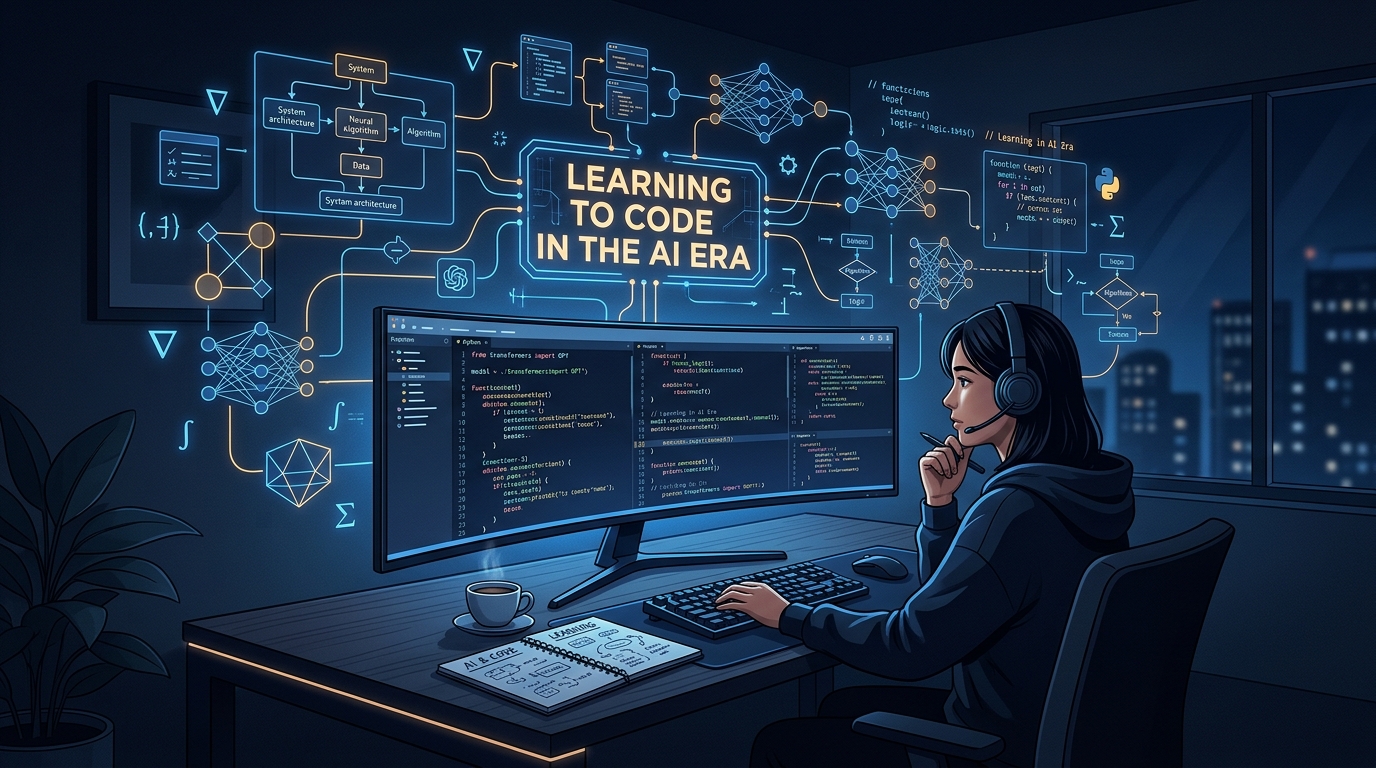
This question comes up in some form every few months: "if AI can write the code, why would I spend months learning to do it myself?" It's a fair question, and the honest answer isn't "yes, obviously" or "no, it's pointless" - it's that the thing worth learning has changed, not disappeared.
What AI is actually good at
Modern coding agents - Cursor, Claude Code, GitHub Copilot, autonomous agents like Devin - are genuinely good at producing working code from a clear description, especially for well-understood problems: CRUD apps, standard UI components, boilerplate, glue code, migrations, dependency bumps. If your job used to be typing out that kind of code by hand, that part of the job is largely gone.
What AI still gets wrong, silently
The gap shows up in exactly the places you'd expect: code that looks correct and runs, but is subtly wrong. Security researchers tracking AI-generated code through 2026 keep finding the same pattern - missing input validation, broken auth checks, and data exposure that a working demo doesn't reveal until it's already live.
An AI agent has no idea what "correct" means for your product, your users, or your compliance requirements unless you tell it - and telling it correctly requires understanding the problem yourself first.
What's actually worth learning now
- Reading code, not just writing it. Reviewing an AI's diff and catching what's wrong is now a bigger part of the job than typing code from scratch.
- System design and architecture. AI is far weaker at "how should these five services actually fit together" than at "write this one function."
- Debugging from first principles. When an AI-generated fix doesn't work, you need to actually understand the system to figure out why.
- Security and data-handling judgment. The single most common way vibe-coded apps fail in public.
- Precise communication. Getting good output from an AI agent is itself a skill - vague prompts get vague, wrong code.
The developers who get stuck
The pattern showing up across 2026 industry surveys is consistent: developers who treat AI output as a black box - accept the suggestion, move on, never actually read it - plateau fast. They can ship a demo. They can't debug it when it breaks, extend it when requirements change, or explain why it works to a teammate. The developers who keep growing are the ones using AI to move faster through the parts they already understand, not to skip understanding entirely.
The practical answer
Yes, still learn to code - but learn it differently than five years ago. Spend less time memorizing syntax (AI autocompletes that instantly) and more time on the things that don't get easier just because a model can generate text: reading unfamiliar code, reasoning about system design, and knowing exactly what to check before you trust an AI's output. That combination - AI fluency plus real engineering judgment - is what's actually in short supply right now.