The Commercial Sports Paywall: Why Developers Get Priced Out Before Writing a Line of Code
If you have ever had an idea for a sports application, you know the excitement that hits first. Maybe you want to build a real-time Premier League goal alert widget, an interactive Formula 1 tire strategy visualizer, or an Indian Premier League (IPL) live ball-by-ball dashboard. You open your code editor, sketch the layout in Figma, design clean state interfaces, and then search online for a live sports data feed.
Then comes the cold shower: commercial sports data vendors like Sportradar, Opta, and Stats Perform demand minimum subscriptions starting at $1,500 to $10,000 per month just to access their staging APIs. If you ask for WebSocket streaming or ball-by-ball feeds, the sales rep sends you an enterprise master services agreement with annual contracts.
When you are grinding in a Tier-3 college hostel or surviving a 3.5 LPA mass-recruiter service bond on a battered 8GB RAM laptop, that pricing is an impossible wall. You do not have corporate backing or venture capital. You have a budget of exactly zero rupees. And when you look at tutorials online, everyone tells you to mock the data with hardcoded JSON arrays.
Here is what happens when you follow that advice: You walk into a technical interview, pull up your portfolio, and the hiring manager clicks a match card. Nothing updates. The scores never change because they are hardcoded. The interviewer nods politely and mentally groups your project with fifty other cookie-cutter clones. If you want to understand why hiring leads dismiss static demo apps, read our breakdown on why you should stop building todo apps and use free public APIs.
Now consider an alternative: You pull up SportSync, a live multi-sport tournament radar running on your Vercel deployment. It pulls live match scores from Football-Data.org with minute-by-minute updates, tracks driver lap deltas and pit stop intervals from Ergast and OpenF1 without requiring a single API key, enriches team crests from TheSportsDB, and handles network dips using smart polling and in-memory caching.
The entire dynamic in that interview flips. The lead engineer is no longer quizzing you on basic array methods. They are asking: "How do you avoid blowing your 10 request-per-minute rate limit on live match days? How do you calculate required run rate without dropping frames? How does your frontend transition from pre-match scheduled states to live in-play rendering?"
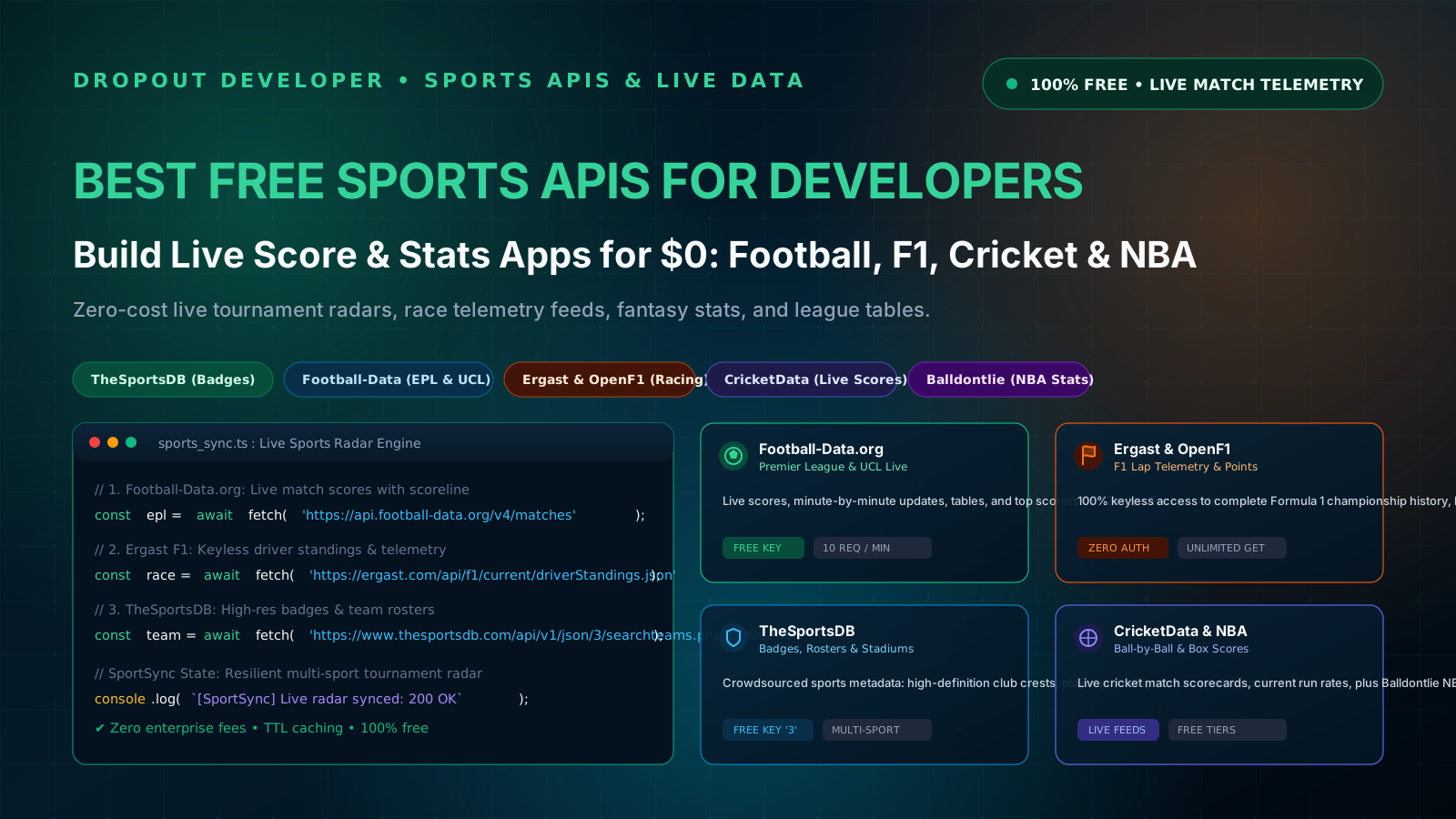
In this guide, we break down the 5 best free sports APIs available for developers today. You will learn their authentication models, rate limits, quirks, and how to combine them into an interview-winning project without spending a single rupee.
1. Football-Data.org: Premier League, Champions League, Live Scores & Standings
If your project involves soccer, Football-Data.org is the gold standard for developer-friendly REST endpoints. Created by Daniel Freitag, it provides reliable, structured football data spanning the top European leagues and international tournaments.
Free Tier Allowance and Covered Competitions
Football-Data.org offers a permanent free tier for individual developers. You register with an email address, verify your account, and receive an API token immediately. The free tier gives you 10 requests per minute, which is more than enough for personal portfolios, dashboard prototypes, and scheduled cron jobs.
The free tier covers 12 major competitions:
- Premier League (PL): English top flight with all 20 clubs, fixtures, live scores, and tables.
- UEFA Champions League (CL): European elite club competition from group stages to finals.
- La Liga (PD): Spanish Primera Division.
- Serie A (SA): Italian top flight.
- Bundesliga (BL1): German first division.
- Ligue 1 (FL1): French top tier.
- Eredivisie (DED) & Primeira Liga (PPL): Dutch and Portuguese leagues.
- Campeonato Brasileiro (BSA): Brazilian Serie A.
- FIFA World Cup & European Championship: International showpiece tournaments.
Core Endpoints and Query Patterns
Authentication is handled via the custom HTTP header X-Auth-Token. Every request to version 4 (https://api.football-data.org/v4/) should pass this header:
GET /v4/matches?status=LIVE: Retrieves all currently active matches across supported leagues with live scorelines.GET /v4/competitions/PL/standings: Returns the full Premier League table with games played, won, drawn, lost, points, goal difference, and recent form indicators (such as W, D, L streaks).GET /v4/competitions/PL/matches?matchday=25: Fetches all fixtures for a specific matchweek with scheduled kickoff timestamps in ISO 8601 UTC.GET /v4/competitions/PL/scorers: Lists the top 10 goalscorers with goals, assists, and penalty conversions.
// Fetching live football scores and Premier League standings
async function fetchFootballData(apiToken) {
  const headers = { 'X-Auth-Token': apiToken };

  // 1. Fetch live in-play matches
  const liveUrl = 'https://api.football-data.org/v4/matches?status=LIVE';
  const liveRes = await fetch(liveUrl, { headers });

  if (!liveRes.ok) {
    throw new Error('Football-Data request failed: ' + liveRes.status);
  }

  const liveData = await liveRes.json();
  const liveMatches = (liveData.matches || []).map(m => ({
    id: m.id,
    competition: m.competition.name,
    homeTeam: m.homeTeam.name,
    awayTeam: m.awayTeam.name,
    homeScore: m.score.fullTime.home ?? m.score.halfTime.home ?? 0,
    awayScore: m.score.fullTime.away ?? m.score.halfTime.away ?? 0,
    minute: m.minute || 'Live',
    status: m.status
  }));

  // 2. Fetch Premier League standings
  const tableUrl = 'https://api.football-data.org/v4/competitions/PL/standings';
  const tableRes = await fetch(tableUrl, { headers });
  const tableData = await tableRes.json();

  const table = (tableData.standings?.[0]?.table || []).map(row => ({
    position: row.position,
    team: row.team.name,
    played: row.playedGames,
    won: row.won,
    draw: row.draw,
    lost: row.lost,
    points: row.points,
    goalDifference: row.goalDifference,
    form: row.form
  }));

  return { liveMatches, table };
}
Architectural Tip: Respect the 10 Requests Per Minute Ceiling
The most common beginner mistake with Football-Data.org is setting a setInterval that calls the API every 3 seconds in the browser. Within 30 seconds, your API token gets rate-limited with HTTP 429 (Too Many Requests), and your UI freezes. In production, use an adaptive polling strategy: poll every 45 to 60 seconds when matches are in play, and drop to once every 10 minutes when all matches are finished.
2. Ergast Developer API & OpenF1: 100% Keyless Formula 1 Racing Telemetry
Formula 1 has exploded into one of the most data-rich sports in modern culture. Fans do not just watch cars circle a tarmac track; they analyze tire degradation curves, DRS activation zones, undercut pit strategy deltas, and micro-sector speeds.
For developers, Formula 1 offers two exceptional free data engines: the legendary Ergast Developer API for historical records and championship standings, and OpenF1 for high-frequency real-time telemetry.
Ergast Developer API: Zero Authentication, Total History
Ergast is completely keyless. You do not need to register, configure tokens, or pass credentials. You simply make standard GET requests directly from your browser or backend. It tracks the complete history of Formula 1 from the inaugural 1950 British Grand Prix to the current season.
Every response is wrapped in an MRData envelope (Motorsport Result Data) formatted in clean JSON:
https://ergast.com/api/f1/current/driverStandings.json: Current Drivers Championship standings with driver codes, constructor names, and accumulated points.https://ergast.com/api/f1/current/last/results.json: Full classification of the most recent Grand Prix, including starting grid position, finishing position, points earned, pit stop count, and fastest lap time.https://ergast.com/api/f1/current/last/laps/1.json: Lap-by-lap timing breakdown for every car on the grid.https://ergast.com/api/f1/current/constructorStandings.json: Constructors Championship points battle.
// Querying Ergast F1 API: 100% keyless driver standings and last race result
async function fetchF1Championship() {
  // Fetch current driver standings
  const standingsUrl = 'https://ergast.com/api/f1/current/driverStandings.json';
  const standingsRes = await fetch(standingsUrl);

  if (!standingsRes.ok) {
    throw new Error('Ergast request failed: ' + standingsRes.status);
  }

  const standingsData = await standingsRes.json();
  const standingsList = standingsData.MRData.StandingsTable.StandingsLists[0]?.DriverStandings || [];

  const drivers = standingsList.slice(0, 10).map(d => ({
    position: d.position,
    points: parseFloat(d.points),
    wins: parseInt(d.wins, 10),
    driverCode: d.Driver.code,
    driverName: d.Driver.givenName + ' ' + d.Driver.familyName,
    nationality: d.Driver.nationality,
    constructor: d.Constructors[0]?.name || 'Unknown'
  }));

  // Fetch results from the most recent Grand Prix
  const lastRaceUrl = 'https://ergast.com/api/f1/current/last/results.json';
  const lastRaceRes = await fetch(lastRaceUrl);
  const lastRaceData = await lastRaceRes.json();

  const race = lastRaceData.MRData.RaceTable.Races[0];
  const podium = (race?.Results || []).slice(0, 3).map(r => ({
    position: r.position,
    driver: r.Driver.familyName,
    constructor: r.Constructor.name,
    time: r.Time?.time || r.status,
    fastestLap: r.FastestLap?.Time?.time || 'N/A'
  }));

  return {
    raceName: race?.raceName,
    circuitName: race?.Circuit?.circuitName,
    podium,
    drivers
  };
}
OpenF1: Modern Real-Time Telemetry REST API
While Ergast handles race results and historical records, OpenF1 (https://api.openf1.org/v1/) is a community open-source REST service that ingests live F1 timing data feeds. It exposes real-time telemetry endpoints without authentication:
/v1/intervals?session_key=latest: Live interval gaps between drivers on track./v1/car_data?driver_number=1&session_key=latest: Instantaneous speed (km/h), RPM, throttle percentage, brake application, and gear selection./v1/stints?session_key=latest: Current tire compounds (Soft, Medium, Hard, Intermediate, Wet) and lap counts on that specific tire set./v1/team_radio?session_key=latest: Audio URLs and driver transcripts of broadcasted team radio messages.
If you love keyless endpoints that let you build slick prototypes without credential friction, explore our curated directory of free public APIs without API keys.
3. TheSportsDB: High-Resolution Badges, Rosters & Stadium Metadata
Here is an issue you will encounter quickly with pure sports score feeds: Football-Data.org and Ergast give you clean numbers, but they do not provide high-resolution graphic assets. If you try to build a clean user interface, your match cards look dry without official club crests, team jerseys, stadium photographs, and player headshots.
That is where TheSportsDB comes in. It is a crowdsourced, open sports metadata database designed specifically for frontend builders, media players, and dashboard creators.
The Community Test Key '3'
TheSportsDB provides a permanent community test API key: the character 3. You can embed this test key directly into query URLs for local development and portfolio showcases without signing up or creating an account:
https://www.thesportsdb.com/api/v1/json/3/searchteams.php?t=Arsenal
For production use with higher limits, developer keys cost just a few dollars on Patreon, but the free test key is fully functional for all primary lookup endpoints.
Multi-Sport Versatility
Unlike single-sport feeds, TheSportsDB covers almost every major sport on the planet:
- Soccer: Over 1,000 leagues with transparent badge PNGs, jersey illustrations, and stadium seating capacities.
- Cricket: IPL franchises, Big Bash League, national cricket boards, and player profiles.
- Motorsport: Formula 1, MotoGP, and NASCAR constructor logos and vehicle graphics.
- Basketball, American Football, Baseball, Tennis, & Rugby: Team rosters, league trophies, and historical championship banners.
// Querying TheSportsDB to enrich team metadata with badges and stadiums
async function fetchTeamMetadata(teamName = 'Arsenal') {
  // Using public community key '3'
  const url = `https://www.thesportsdb.com/api/v1/json/3/searchteams.php?t=` + encodeURIComponent(teamName);

  const res = await fetch(url);
  if (!res.ok) {
    throw new Error('TheSportsDB query failed: ' + res.status);
  }

  const data = await res.json();
  const team = data.teams?.[0];

  if (!team) return null;

  return {
    id: team.idTeam,
    name: team.strTeam,
    badgeUrl: team.strBadge,      // High-resolution transparent PNG badge
    jerseyUrl: team.strEquipment,  // Official home kit graphic
    stadium: team.strStadium,
    stadiumCapacity: parseInt(team.intStadiumCapacity, 10),
    stadiumLocation: team.strStadiumLocation,
    stadiumThumb: team.strStadiumThumb, // High-res stadium photo
    foundedYear: team.intFormedYear,
    website: team.strWebsite
  };
}
By pairing TheSportsDB badge URLs with Football-Data.org live scores, your application transforms from a plain text list into a broadcast-quality dashboard.
4. CricketData / Free Cricket API: Real-Time Ball-by-Ball Cricket Telemetry
For developers in India, England, Australia, South Africa, and across the sub-continent, cricket is not just a weekend pastime: it is an obsession. Over 500 million fans watch tournaments like the Indian Premier League (IPL) and ICC Men's T20 World Cup.
Unfortunately, official cricket boards guard their telemetry jealously. Commercial feeds from Cricbuzz or Opta charge enormous fees. Fortunately, services like CricketData (formerly CricAPI) offer free developer tiers designed for indie developers and student portfolios.
Free Tier Capabilities
CricketData provides an instant free API key upon sign-up, offering 100 free API hits per day. While this is not meant for high-concurrency production servers, it is ideal for student portfolios, cron-based daily digest bots, and live score popups with smart local caching.
What You Can Track
- Live Match State: In-play scores, overs bowled, wickets lost, and current batting strike rates.
- Match Phase Status: Distinguishes between
Scheduled,In Progress,Innings Break,Rain Interruption, andMatch Ended. - Match Outcomes: Runs margin, wickets margin, and Super Over classifications.
- Upcoming Tournaments: Complete international tour schedules, Bilateral Series, and IPL fixtures.
// Querying CricketData API for live match scores and current run rates
async function fetchCricketLiveScore(apiKey) {
  const url = new URL('https://api.cricapi.com/v1/cricScore');
  url.searchParams.set('apikey', apiKey);

  const res = await fetch(url.toString());
  if (!res.ok) {
    throw new Error('Cricket API request failed: ' + res.status);
  }

  const payload = await res.json();
  const matches = payload.data || [];

  return matches.map(m => {
    // Score string example: "184/4 (18.2 ov)"
    const currentRunRate = (m.r && m.o) ? (m.r / m.o).toFixed(2) : 'N/A';

    return {
      id: m.id,
      name: m.name,           // e.g. "India vs Australia"
      status: m.status,       // e.g. "India need 24 runs in 16 balls"
      matchType: m.matchType, // e.g. "t20", "odi", "test"
      team1: m.t1,
      team2: m.t2,
      team1Score: m.t1s || 'Yet to bat',
      team2Score: m.t2s || 'Yet to bat',
      currentRunRate,
      isLive: m.ms === 'live'
    };
  });
}
Optimizing Cricket Feeds for $0 Budgets
Because free cricket API limits are capped at 100 hits per day, you cannot fire a request every 10 seconds. The solution is caching: fetch the score once every 90 seconds during active balls, and if the match state says Innings Break or Stumps, put the fetcher to sleep for 20 minutes. This extends your 100 daily hits across the entire match without burning your quota.
5. Balldontlie API: 100% Free NBA Stats, Box Scores & Player Averages
If you want to build an application for basketball, the Balldontlie API (api.balldontlie.io) is hands down the cleanest sports data service on the internet. Built by independent developers who were tired of corporate paywalls, it provides a fast, predictable REST architecture for all NBA historical and live data.
Key Features and Generous Free Tier
Balldontlie requires a free API key registered via their developer portal. The free tier gives you access to full game schedules, team profiles, player rosters, and live game states.
- Player Career Averages: Points, rebounds, assists, steals, blocks, turnovers, field goal percentages, and 3-point accuracy.
- Live NBA Game State: Current quarter (1st, 2nd, 3rd, 4th, OT), time remaining on the game clock, and quarter-by-quarter score progression.
- Historical Box Scores: Complete box scores dating back to the 1979 season.
- Team Rosters & Conferences: Eastern and Western conference standings, team divisions, and official franchise abbreviations.
// Querying Balldontlie API for today's NBA games and live quarter scores
async function fetchNbaDailyScoreboard(apiKey, dateStr = '2024-03-24') {
  const url = new URL('https://api.balldontlie.io/v1/games');
  url.searchParams.set('dates[]', dateStr);

  const res = await fetch(url.toString(), {
    headers: { 'Authorization': apiKey }
  });

  if (!res.ok) {
    throw new Error('Balldontlie request failed: ' + res.status);
  }

  const payload = await res.json();
  const games = payload.data || [];

  return games.map(g => ({
    id: g.id,
    homeTeam: g.home_team.full_name,
    homeAbbr: g.home_team.abbreviation,
    awayTeam: g.visitor_team.full_name,
    awayAbbr: g.visitor_team.abbreviation,
    homeScore: g.home_team_score,
    awayScore: g.visitor_team_score,
    status: g.status, // e.g. "Final", "3rd Qtr 4:12"
    period: g.period,
    postseason: g.postseason
  }));
}
Feature Comparison: The Free Sports API Landscape
Here is how the five free sports APIs compare across authentication models, free quotas, CORS support, live latency, and primary portfolio applications:
| API Service | Auth Method | Free Quota | CORS Support | Live Latency | Best Portfolio Use Case |
|---|---|---|---|---|---|
| Football-Data.org | Free API Token (Header) | 10 requests / min | Requires Proxy / Server | ~60 seconds | European league tables, live match trackers, goal alerts |
| Ergast & OpenF1 | 100% Keyless (Zero Auth) | Unlimited fair use | Yes (Native Browser) | Real-time (OpenF1) | F1 lap comparison, tire strategy charts, podium histories |
| TheSportsDB | Free Key ('3') | Generous fair use | Yes (Native Browser) | Static / Metadata | Team crests, player portraits, stadium photos, league branding |
| CricketData API | Free API Key (Query param) | 100 requests / day | Yes | ~30-60 seconds | Ball-by-ball match cards, floating score widget, IPL schedules |
| Balldontlie API | Free API Key (Header) | 30 requests / min | Requires Proxy / Server | Live quarter scores | NBA fantasy comparisons, box scores, shot form statistics |
Production Project Blueprint: SportSync - Multi-Sport Live Tournament Radar & Fantasy Form Analyzer
To turn these open endpoints into an interview-winning project, let us examine the architecture of SportSync. Instead of building another isolated single-sport page, SportSync acts as a unified multi-sport tournament radar combining football fixtures, F1 race telemetry, and cricket scorecards into one cohesive dashboard.
System Architecture and Data Pipeline
- Adaptive Polling Engine (State Machine):
- When a fixture has the status
SCHEDULED, the client checks once every 15 minutes. - When the status transitions to
IN_PLAY,LIVE, orQTR_ACTIVE, the client accelerates polling to once every 45 seconds. - When the status becomes
FINISHED, polling stops completely for that fixture.
- When a fixture has the status
- In-Memory TTL Caching: Every network response is stored in a client-side cache keyed by endpoint and query parameters. League tables are cached for 10 minutes (standings do not change every second). Live match scores are cached for 30 seconds. If two components request the same league table simultaneously, only one network request fires.
- Visual Asset Enrichment: When Football-Data.org returns raw match strings ("Arsenal" vs "Chelsea"), the client passes those names through an in-memory lookup map backed by TheSportsDB to retrieve official transparent badge PNGs and stadium names.
- Optimistic UI and Stale-While-Revalidate: If a user switches tabs and returns, the dashboard displays cached scores instantly with a subtle pulsating indicator: "Synced 28s ago". If an upstream API returns an error or rate limit, the cached state remains visible with a graceful offline warning instead of a blank white screen.
Production TypeScript Code: Resilient Multi-Sport Client Engine
Here is a complete, copy-pasteable TypeScript module implementing in-memory caching, adaptive polling, timeout abort controllers, and unified multi-sport ingestion:
/**
 * SportSync Multi-Sport Live Radar Engine
 * Production-ready TypeScript module with TTL caching, timeouts, and state machines
 */

export interface LiveFootballMatch {
  id: number;
  competition: string;
  homeTeam: string;
  awayTeam: string;
  homeScore: number;
  awayScore: number;
  status: 'SCHEDULED' | 'IN_PLAY' | 'PAUSED' | 'FINISHED';
  minute: string | number;
  updatedAt: string;
}

export interface F1DriverStanding {
  position: number;
  points: number;
  driverCode: string;
  driverName: string;
  constructorName: string;
}

export interface CricketMatchSummary {
  id: string;
  title: string;
  status: string;
  team1: string;
  team2: string;
  score1: string;
  score2: string;
  isLive: boolean;
}

export interface UnifiedSportFeed {
  football: LiveFootballMatch[];
  formula1: F1DriverStanding[];
  cricket: CricketMatchSummary[];
  syncedAt: string;
}

interface CacheEntry<T> {
  data: T;
  expiresAt: number;
}

/**
 * In-memory TTL Cache Layer
 */
class SportsMemoryCache {
  private cache = new Map<string, CacheEntry<any>>();

  get<T>(key: string): T | null {
    const entry = this.cache.get(key);
    if (!entry) return null;
    if (Date.now() > entry.expiresAt) {
      this.cache.delete(key);
      return null;
    }
    return entry.data as T;
  }

  set<T>(key: string, data: T, ttlSeconds: number): void {
    this.cache.set(key, {
      data,
      expiresAt: Date.now() + ttlSeconds * 1000
    });
  }

  clear(): void {
    this.cache.clear();
  }
}

export const sportsCache = new SportsMemoryCache();

/**
 * 1. Fetch live football matches with AbortController timeout
 */
export async function fetchLiveFootballMatches(
  apiToken: string,
  timeoutMs: number = 6000
): Promise<LiveFootballMatch[]> {
  const cacheKey = 'football_live_matches';
  const cached = sportsCache.get<LiveFootballMatch[]>(cacheKey);
  if (cached) return cached;

  const controller = new AbortController();
  const timer = setTimeout(() => controller.abort(), timeoutMs);

  try {
    const url = 'https://api.football-data.org/v4/matches?status=LIVE';
    const res = await fetch(url, {
      headers: { 'X-Auth-Token': apiToken },
      signal: controller.signal
    });

    if (!res.ok) {
      throw new Error(`Football-Data API error: HTTP ${res.status}`);
    }

    const payload = await res.json();
    const matches: LiveFootballMatch[] = (payload.matches || []).map((m: any) => ({
      id: m.id,
      competition: m.competition?.name || 'Football',
      homeTeam: m.homeTeam?.name || 'Home Team',
      awayTeam: m.awayTeam?.name || 'Away Team',
      homeScore: m.score?.fullTime?.home ?? m.score?.halfTime?.home ?? 0,
      awayScore: m.score?.fullTime?.away ?? m.score?.halfTime?.away ?? 0,
      status: m.status,
      minute: m.minute || 'Live',
      updatedAt: new Date().toISOString()
    }));

    // Cache live matches for 35 seconds to respect 10 req/min rate limit
    sportsCache.set(cacheKey, matches, 35);
    return matches;
  } catch (err: any) {
    if (err.name === 'AbortError') {
      console.warn('Football-Data request timed out.');
    } else {
      console.error('Failed to fetch football matches:', err.message);
    }
    return [];
  } finally {
    clearTimeout(timer);
  }
}

/**
 * 2. Fetch current Formula 1 driver standings (100% keyless)
 */
export async function fetchF1Standings(timeoutMs: number = 6000): Promise<F1DriverStanding[]> {
  const cacheKey = 'f1_driver_standings';
  const cached = sportsCache.get<F1DriverStanding[]>(cacheKey);
  if (cached) return cached;

  const controller = new AbortController();
  const timer = setTimeout(() => controller.abort(), timeoutMs);

  try {
    const url = 'https://ergast.com/api/f1/current/driverStandings.json';
    const res = await fetch(url, { signal: controller.signal });

    if (!res.ok) {
      throw new Error(`Ergast API error: HTTP ${res.status}`);
    }

    const payload = await res.json();
    const standingsList = payload.MRData?.StandingsTable?.StandingsLists?.[0]?.DriverStandings || [];

    const standings: F1DriverStanding[] = standingsList.slice(0, 10).map((item: any) => ({
      position: parseInt(item.position, 10),
      points: parseFloat(item.points),
      driverCode: item.Driver?.code || 'DRV',
      driverName: `${item.Driver?.givenName || ''} ${item.Driver?.familyName || ''}`.trim(),
      constructorName: item.Constructors?.[0]?.name || 'Constructor'
    }));

    // F1 standings change once per race weekend: cache for 1 hour
    sportsCache.set(cacheKey, standings, 3600);
    return standings;
  } catch (err: any) {
    console.error('Failed to fetch F1 standings:', err.message);
    return [];
  } finally {
    clearTimeout(timer);
  }
}

/**
 * 3. Fetch live cricket score summaries
 */
export async function fetchCricketScores(apiKey?: string): Promise<CricketMatchSummary[]> {
  if (!apiKey) return [];
  const cacheKey = 'cricket_scores_summary';
  const cached = sportsCache.get<CricketMatchSummary[]>(cacheKey);
  if (cached) return cached;

  try {
    const url = new URL('https://api.cricapi.com/v1/cricScore');
    url.searchParams.set('apikey', apiKey);

    const res = await fetch(url.toString());
    if (!res.ok) throw new Error(`Cricket API error: HTTP ${res.status}`);

    const payload = await res.json();
    const data = payload.data || [];

    const summaries: CricketMatchSummary[] = data.slice(0, 6).map((m: any) => ({
      id: m.id,
      title: m.name,
      status: m.status,
      team1: m.t1,
      team2: m.t2,
      score1: m.t1s || 'Yet to bat',
      score2: m.t2s || 'Yet to bat',
      isLive: m.ms === 'live'
    }));

    // Cache cricket scores for 60 seconds to preserve 100 hits/day quota
    sportsCache.set(cacheKey, summaries, 60);
    return summaries;
  } catch (err: any) {
    console.error('Failed to fetch cricket scores:', err.message);
    return [];
  }
}

/**
 * 4. Unified SportSync Telemetry Aggregator
 */
export async function getSportSyncRadar(
  footballToken: string,
  cricketKey?: string
): Promise<UnifiedSportFeed> {
  const [footballResult, f1Result, cricketResult] = await Promise.allSettled([
    fetchLiveFootballMatches(footballToken),
    fetchF1Standings(),
    fetchCricketScores(cricketKey)
  ]);

  return {
    football: footballResult.status === 'fulfilled' ? footballResult.value : [],
    formula1: f1Result.status === 'fulfilled' ? f1Result.value : [],
    cricket: cricketResult.status === 'fulfilled' ? cricketResult.value : [],
    syncedAt: new Date().toISOString()
  };
}
Solving the Network Wall: Handling CORS and Rate Limits in Sports APIs
When you query sports APIs directly from a React, Vue, or Angular application running on localhost:3000 or your live Vercel domain, you will run into Cross-Origin Resource Sharing (CORS) blocks on certain endpoints. For example, Football-Data.org and Balldontlie enforce server-to-server security on their free tiers, refusing direct client browser requests that include private API tokens.
Some beginners install browser extensions that disable CORS locally. Never do this. That makes the project look fine on your laptop, but when an interviewer or recruiter visits your live demo, every request fails with a red console error.
The clean, professional solution is to create a lightweight serverless proxy. In Next.js, this takes only ten lines of code in /pages/api/football.ts or /app/api/football/route.ts:
// Next.js Serverless Route: /app/api/football/route.ts
import { NextResponse } from 'next/server';

export async function GET() {
  const token = process.env.FOOTBALL_DATA_API_KEY;
  if (!token) {
    return NextResponse.json({ error: 'Missing API key' }, { status: 500 });
  }

  const res = await fetch('https://api.football-data.org/v4/matches?status=LIVE', {
    headers: { 'X-Auth-Token': token },
    next: { revalidate: 30 } // Next.js server-side edge caching for 30 seconds
  });

  if (!res.ok) {
    return NextResponse.json({ error: 'Upstream error' }, { status: res.status });
  }

  const data = await res.json();
  return NextResponse.json(data);
}
This proxy pattern hides your private token from the public browser inspection tab and completely eliminates CORS issues. For a deeper breakdown of proxy strategies and header fixes, review our guide on how to fix CORS errors when calling public APIs.
The Elder Brother Takeaway: Build for Passion and Engineering Craft
When you learn programming on your own or graduate from a college that does not attract high-paying tech placements, building projects can feel like shouting into the void. Everyone tells you to code, but no one tells you what makes an application memorable.
Sports apps stand out because they demand genuine engineering discipline. You cannot fake a live score. You cannot hide behind static mock data when an interviewer asks how your application behaves during injury time or a red-flagged Grand Prix. Building a tool like SportSync proves that:
- You respect network constraints: You know how to manage strict rate limits with adaptive polling and in-memory TTL caching.
- You know how to handle live state: Your UI can gracefully transition between scheduled, live, paused, and finished states without crashing the browser.
- You design resilient architectures: You use
Promise.allSettled()so that if one sport provider undergoes maintenance, the rest of your dashboard remains fast and responsive.
Grab a free token from Football-Data.org, query Ergast keyless endpoints, enrich your UI with TheSportsDB badges, and deploy your live sports radar to the world. When your next interview begins, do not explain what you could build: show them the live scores running on your screen.