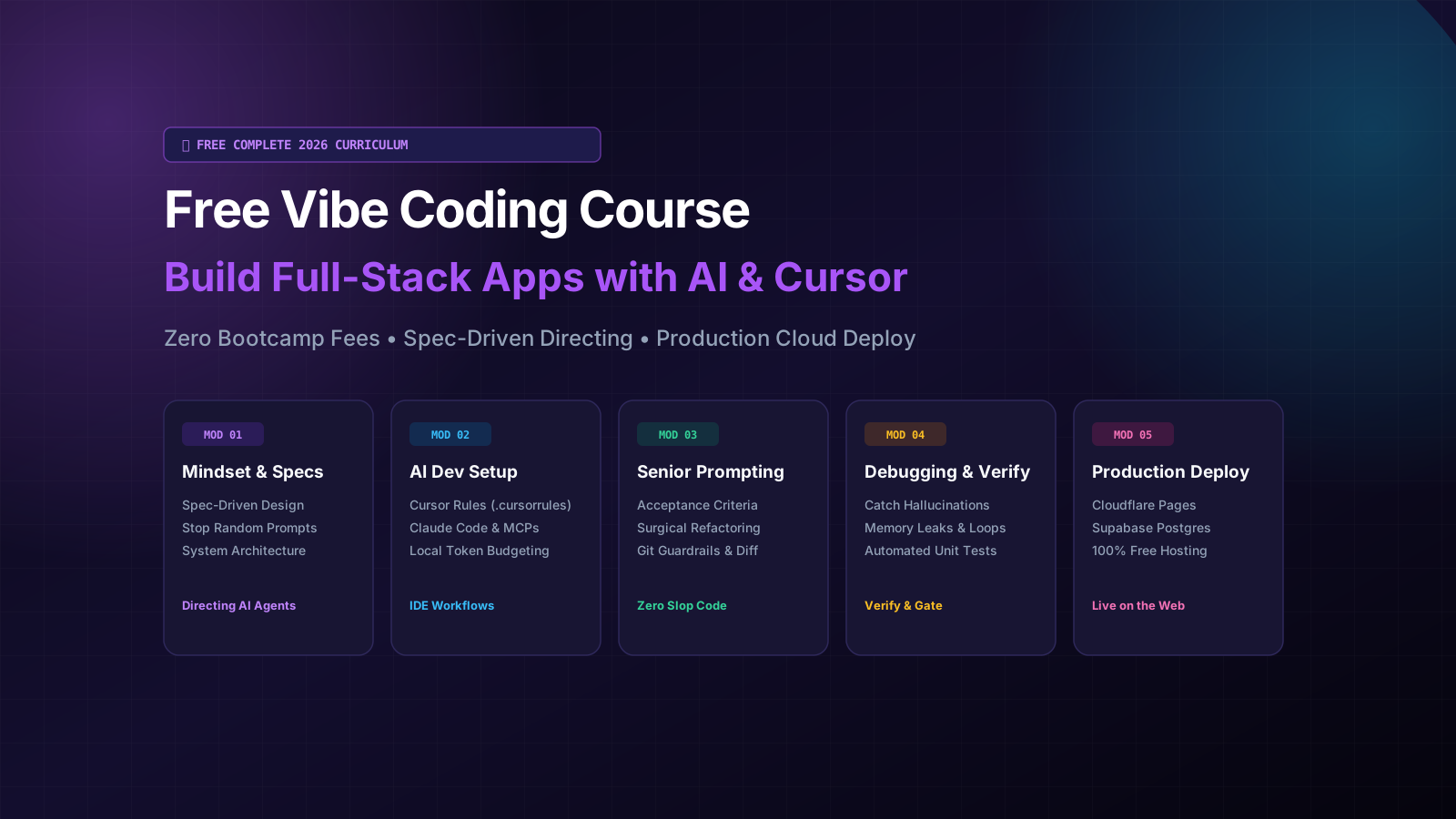
The Vibe Coding Trap: Why Prompting Without Engineering Always Crashes
Vibe coding is not typing random prompts and hoping an AI builds your app: that approach leads to hallucinated npm dependencies, runaway database migrations, memory leaks, and $50 in burned API tokens. True vibe coding in 2026 is Spec-Driven Directing: you act as the Senior Tech Lead who writes explicit architecture constraints, verifies git diffs, and enforces runtime boundaries, while the AI agent (Cursor, Claude Code, Antigravity) handles the manual keystroke labor. This free 5-module curriculum teaches you how to direct AI from initial idea to live production deployment for $0.
When the term "vibe coding" exploded across social media, every influencer started claiming that learning software engineering was dead. "Just sit back with your coffee, type 'build me an Airbnb clone with payments', and vibe your way to a million-dollar startup!"
Sounds incredible, right? It is also a complete lie.
I know what happens when a beginner tries that naive approach, because I have reviewed dozens of broken pull requests from developers who tried to "vibe code" without fundamentals. Here is the reality:
- The AI writes 600 lines of spaghetti code in a single file.
- It hallucinates an npm package that was deprecated four years ago.
- It creates a React
useEffecthook with missing dependencies that triggers an infinite network loop, blowing through your free Supabase database quota in twenty minutes. - When a bug occurs, the developer asks the AI to "fix it", and the AI quietly deletes the broken feature instead of debugging the root cause.
- You wake up to a $40 Anthropic API bill and an app that cannot even pass a production build step.
Does this mean AI coding tools are useless? Absolutely not. AI coding agents have completely transformed how I write software. Tasks that used to take me two days of tedious boilerplate now take twenty minutes. But the developers who succeed with AI are not "vibing" randomly: they are directing AI agents like a Senior Tech Lead directs an eager junior engineer.
You do not need to spend ₹50,000 or ₹1,50,000 on private "AI developer bootcamps". In this free, self-paced masterclass, I will teach you the exact mental models, system prompts, git guardrails, and verification workflows needed to build production-grade web applications with modern AI tools.
The 5-Module Free Vibe Coding Roadmap
Here is your complete curriculum, organized into five sequential engineering modules. No corporate theory: only practical blueprints and working code.
Module 1: The Vibe Coding Mindset: Spec-Driven Architecture vs Random Prompting
The single biggest mistake junior developers make with AI is opening Cursor or Claude Code and typing: "Build me an expense tracker."
Because the prompt has zero boundaries, the AI has to guess everything: the database schema, the state management model, the authentication provider, and the API contract. Inevitably, it guesses poorly.
The Spec-First Law
Before you let an AI write a single line of code, you must create a written specification file in your project root called SPEC.md or ARCHITECTURE.md. This document acts as the constitution for your AI agents:
- Domain Modeling: What are the core entities? (e.g.
User,Transaction,Category). What are their exact database types and foreign key relationships? - Boundary Definition: What will this project NOT do? Explicit negative constraints prevent the AI from installing bloated utility libraries or adding unnecessary complexity.
- API Contract: What are the exact request and response JSON schemas for every endpoint before writing the implementation?
When you provide an AI agent with a rigid SPEC.md, hallucinations drop by over 80% because the model is constrained by your architectural boundaries.
Module 2: The Modern AI Dev Setup: Cursor, Claude Code, and Local Acceleration
Your tools determine your speed. Trying to write code by manually copying and pasting text back and forth between a web browser chat window and your editor is the slowest way to work.
1. Mastering Cursor Rules (.cursorrules)
Cursor is an AI-first code editor built on VS Code. Its most powerful feature is the project-level .cursorrules file. This file automatically injects context into every prompt behind the scenes:
# Project Guidelines (.cursorrules)
- Framework: Next.js 15 (App Router), TypeScript 5.5, Tailwind CSS v4.
- State: Server Components by default. Use 'use client' only for leaf interactive components.
- Database: Supabase PostgreSQL with drizzle-orm. Never use raw SQL strings.
- Error Handling: Return standard Result tuples: [data, null] | [null, error]. Never throw uncaught exceptions.
- Style: Minimal, clean, dark-mode first. Zero third-party icon packages; use lucide-react.
- Typography Rule: Absolutely ZERO em-dashes (U+2014) in text or comments. Use colons or hyphens.
2. Claude Code and Model Context Protocol (MCP)
For terminal-heavy workflows, Claude Code runs directly in your CLI. By configuring MCP servers (Model Context Protocol), you can give your terminal AI direct read and write access to your local Postgres database, GitHub issues, and browser devtools, allowing it to inspect logs and diagnose failures autonomously.
3. Local Token Hygiene: Never Blow Your Budget
If you are an Indian developer working with limited savings, you cannot afford to burn $10 every day on cloud API tokens. We will teach you how to:
- Keep prompt context small by using targeted file references (e.g.
@file.ts#L20-L50instead of loading the entire codebase). - Use free open-weight models locally via Ollama or LM Studio for quick boilerplate generation.
- Save frontier cloud models (Claude 3.5 Sonnet, GPT-4o) exclusively for high-complexity architectural refactoring.
Module 3: Prompting Like a Senior Tech Lead: Acceptance Criteria and Git Safety
Junior developers talk to AI like a magic genie: "Please make this page look nicer."
Senior Tech Leads talk to AI like an engineering contractor: "Refactor this component according to these four explicit acceptance criteria."
The 4-Part Senior Prompting Formula
Every effective engineering prompt follows this exact four-stage structure:
1. CONTEXT: "We have an Express 5 authentication endpoint in src/routes/auth.ts using Argon2 password hashing."
2. INTENT: "We need to implement a Redis-backed rate limiter for login attempts."
3. CONSTRAINTS: "Maximum 5 failed attempts per IP address within a 15-minute sliding window. Do not install express-rate-limit; use our existing ioredis client. If rate limited, return HTTP 429 with a 'Retry-After' header in seconds."
4. ACCEPTANCE CRITERIA:
   - Provide a clean TypeScript middleware function in src/middleware/rateLimiter.ts.
   - Include automated unit tests in tests/rateLimiter.test.ts using Vitest.
   - Do not modify any files outside of these two paths.
Git Guardrails and Atomic Commits
Never let an AI agent edit five different files across your repo without committing first. Follow the One-Prompt-One-Commit Rule:
- Ensure your git working tree is completely clean (
git status). - Give the AI a single atomic task.
- Run
git diffand read every single changed line. If the AI touched unrelated code, revert it immediately. - Verify tests pass.
- Commit with a concise commit message (e.g.
feat(auth): add redis login rate limiter).
If the AI makes a mess, you can run git reset --hard HEAD and roll back in one second. You never lose working code.
Module 4: Verification and Debugging: Catching Hallucinations and Memory Leaks
Anyone can prompt an AI to generate code that looks pretty. But does it actually run in production under heavy load? This module is where you separate yourself from 99% of "AI prompt engineers".
1. The Test-Driven Vibe Loop (TDD with AI)
The safest way to vibe code is to ask the AI to write the tests before the implementation:
- Feed your API contract into the AI: "Write 5 Vitest unit tests covering valid payloads, expired tokens, malformed JSON, and rate limit breaches for this endpoint."
- Run the tests. They should all fail (Red state).
- Now ask the AI to write the implementation until all tests pass (Green state).
- Because the tests define truth, the AI cannot cheat or hallucinate working behavior.
2. Catching Zombie Re-Renders and Memory Leaks
AI models notoriously struggle with frontend state synchronization. We teach you how to inspect Chrome DevTools Performance profiles to catch:
- Unmemoized callbacks causing 120 re-renders per second.
- Orphaned event listeners on
window.addEventListener('resize')that never get cleaned up inside return functions. - Uncancelled network requests when switching pages quickly.
Module 5: Production Deployment and Free Cloud Hosting
A project sitting on localhost:3000 does not get you a job. Hiring managers want to click a live HTTPS link, test your authentication, and see real data persist across sessions.
You do not need an expensive AWS or GCP account with high monthly minimums. We will guide you through deploying your entire full-stack app for exactly ₹0 using production-grade free cloud tiers:
| Layer | Free Cloud Provider | Free Tier Allowance | Cost |
|---|---|---|---|
| Frontend Hosting | Cloudflare Pages / Vercel | Unlimited bandwidth, global edge CDN, custom SSL | $0 / ₹0 |
| Relational Database | Supabase / Neon | 500MB PostgreSQL, automated backups, instant pooling | $0 / ₹0 |
| Backend Compute | Cloudflare Workers / Render | 100,000 edge requests / day or 750 free server hours | $0 / ₹0 |
| Authentication | Supabase Auth / Clerk | Up to 10,000 monthly active users (MAU) | $0 / ₹0 |
| Object Storage | Cloudflare R2 | 10GB storage, 10M read requests, zero egress fees | $0 / ₹0 |
Start Learning on Dropout Developer
Learn real software engineering, full-stack web development, and backend system architecture without paying for expensive coaching or bootcamps. Our complete learning paths are 100% free forever.
Course Curriculum Breakdown: Hours, Projects, and Deliverables
Here is an overview of what you will build as you progress through each module of this course:
| Module | Core Skill | Key Tools | Hands-On Deliverable |
|---|---|---|---|
| Module 1 | Spec-Driven Architecture | Markdown, Mermaid.js, Domain Models | A complete SPEC.md and ERD for a SaaS application |
| Module 2 | AI IDE Configuration | Cursor, .cursorrules, Claude Code, MCP |
A tailored developer environment with automated context rules |
| Module 3 | Senior Prompt Engineering | Git, Vitest, 4-Part Prompt Formula | Production REST API with 100% unit test coverage |
| Module 4 | Verification & Performance | Chrome DevTools, Profiler, Network Tab | Optimized frontend with zero memory leaks and zero re-renders |
| Module 5 | Production $0 Deployment | Cloudflare Pages, Supabase, GitHub Actions | A live, production-deployed full-stack app on a custom domain |
Why Vibe Coding Makes You More Valuable, Not Obsolete
If you talk to engineers in Tier-3 colleges or mass-recruiter training batches in India, there is a lot of anxiety right now. People ask: "If AI can write code, why should anyone hire me?"
Here is the truth: companies do not hire software engineers just to type syntax. If typing syntax was all that mattered, the fastest typist in the world would be the highest-paid engineer. Companies hire engineers to solve business problems, design reliable systems, prevent downtime, and ensure security.
An average developer who refuses to use AI will take two weeks to build a CRUD app. A naive "vibe coder" who only types vague prompts will build an insecure, broken app that crashes on day one.
But an engineer who understands system architecture, database design, and git discipline, and who uses AI agents to execute that vision at 10x speed: that developer is unstoppable. You can ship in three days what used to require an entire agency team.
Stop fearing AI. Stop throwing vague prompts at chatbots. Learn to direct AI like an engineering leader, build real projects, and prove your capabilities to the world.
Frequently Asked Questions (FAQ)
Is this free vibe coding course really 100% free?
Yes. Dropout Developer is a 100% free hobby initiative. There are no paid upsells, no hidden fees, and no private paywalls. All guides, code templates, and curriculums are accessible to every developer for ₹0.
Do I still need to learn coding fundamentals in the AI era?
Yes, absolutely. You need to understand data structures, HTTP status codes, SQL relationships, and state management. Without fundamentals, you cannot spot when an AI hallucinates a nonexistent function, introduces an N+1 database query, or writes a security vulnerability.
Which AI tool is best for vibe coding: Cursor, Claude Code, or Antigravity?
Cursor is the best IDE for interactive visual development, component styling, and inline refactoring. Claude Code is the best tool for terminal-based automation, git workflows, and repository-wide refactoring. Using both together gives you the ultimate productivity stack.
Can I get a software engineering job by vibe coding?
You can get hired if your portfolio demonstrates solid engineering thinking. Hiring managers will test you on architectural decisions, database modeling, and how you debug production issues. If you can explain every line of your codebase and showcase live deployed apps, AI acceleration is viewed as a major productivity advantage.
How do I avoid wasting money on API tokens while vibe coding?
Always use small, targeted file context instead of feeding entire folders into prompts. Use local models via Ollama for quick boilerplate, and enforce strict acceptance criteria so the AI completes tasks in a single attempt rather than spinning in multiple retry loops.